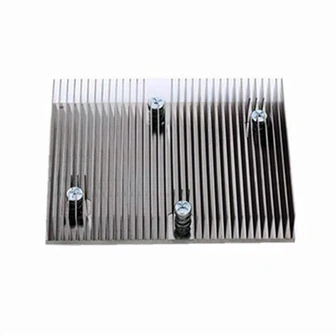
3D VC Thermal solutions
With the rapid development of 5G technology and data centers, efficient cooling and thermal management have become critical challenges in the design of 5G base stations, GPUs, and servers. In this context, 3D VC (Vapor Chamber) technology-an innovative three-dimensional two-phase thermal equalization solution-has emerged as an effective thermal management approach for 5G base stations, servers, and GPUs.
Key Highlights:
Industry Demand: Rising power densities in 5G infrastructure and high-performance computing necessitate advanced cooling solutions.
3D VC Technology:
Leverages two-phase heat transfer for superior thermal uniformity
3D design enables compact integration with complex geometries (e.g., multi-chip modules)
Addresses hotspot challenges in 5G mMIMO antennas, GPU clusters, and rack-scale servers
Applications:
5G Base Stations: Mitigates heat from power amplifiers in compact enclosures
Data Centers: Enhances reliability of liquid-cooled GPU racks
Edge Computing: Supports passive cooling for energy-efficient deployments
Technical Advantage:
Compared to traditional heat pipes or solid conduction, 3D VCs offer:
✓ 30–50% lower thermal resistance (experimental data)
✓ <1°C temperature variance across heat sources
✓ Scalability from chip-level to system-level cooling
3D VC Overview
Two-phase heat transfer leverages the latent heat of working fluid phase change to achieve high thermal efficiency and excellent temperature uniformity, making it increasingly adopted in electronics cooling in recent years. The evolution of thermal equalization technology has progressed from 1D (linear) heat pipes to 2D (planar) vapor chambers (VCs), culminating in 3D integrated thermal equalization-the 3D VC technology pathway.

2.2 Definition & Working Principle
3D VC involves welding a substrate cavity to PCI fin cavities, forming an integrated chamber. The chamber is filled with a working fluid and sealed. Heat transfer occurs via:
Evaporation: Fluid evaporates at the substrate cavity (near the chip).
Condensation: Vapor condenses at the fin cavities (away from the heat source).
Gravity-driven circulation: Designed flow paths enable continuous two-phase cycling, achieving optimal temperature uniformity.
2.3 Technical Advantages
3D VC significantly expands thermal equalization range and enhances heat dissipation capacity, offering:
Ultra-high thermal conductivity
Superior temperature uniformity
Compact, integrated structure
By unifying the substrate and fins into a single 3D design, it:
✓ Reduces thermal gradients between components
✓ Improves convective heat transfer efficiency
✓ Lowers chip temperatures in high-heat-flux zones
This technology is pivotal for 5G base stations, enabling miniaturization and lightweight designs.
Part 3: 3D VC in 5G Base Stations
3.1 Thermal Challenges
5G base stations face localized high-heat-flux chips, where conventional solutions-thermal interface materials, housing materials, and 2D VCs (substrate HPs/fin PCIs)-only marginally reduce thermal resistance.
3.2 Benefits of 3D VC
Without external moving parts, 3D VC delivers:
Efficient heat spreading via 3D architecture
Uniform temperature distribution (≤3°C variance)
Hotspot mitigation for high-power components
3.3 Case Study: ZTE & FERROTEC
A joint prototype demonstrated:
>10°C reduction in Tmax vs. PCI-based designs
Substrate/fin uniformity maintained within 3°C
Validated feasibility for smaller, lighter base stations
Part 4: Future Prospects
4.1 Technical Innovations
Further optimization potential includes:
Materials: Lightweight, high-conductivity shells; advanced working fluids
Structures: Novel supports, fin architectures, and assembly designs
Processes: Tube forming, fin cutting, welding, capillary wick fabrication
Two-phase enhancement: Flow path design, localized boiling structures, anti-gravity fluid replenishment
4.2 Market Outlook
5G-Driven Demand: 3D VC overcomes material limits, enabling high-density, lightweight designs.
Emerging Applications: Aluminum 3D VCs are gaining traction in IT and PV inverters, with rapid growth in telecom.
Reliability Challenges: Station maintenance-free requirements demand rigorous process controls. While some firms remain cautious, others are actively advancing supplier chain and R&D.
Conclusion: 3D VC is a transformative technology for next-gen thermal management, poised to redefine 5G infrastructure cooling.