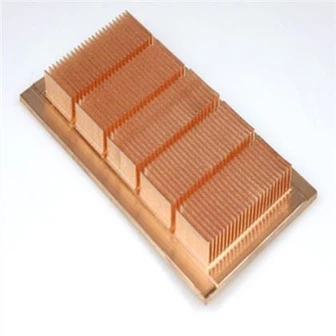
3D printing Heatsink design
Designing heatsink for the small electronic devices such as LEDs and computer chips requires a delicate balance between design requirements: they need to be as small and lightweight as possible while providing extremely powerful heat dissipation. The heatsink of traditional design is too heavy. We can use topology optimization to reduce the mass and sacrifice the cooling power as little as possible.

When the design of geometric structure is very complex, how to make radiator? An additive manufacturing process called selective laser melting (SLM) has emerged. This process is very suitable for producing radiators with topology optimization design, because the precision of laser makes it possible to manufacture complex and detailed geometry.
In order to find the heatsink design with the least performance loss, we compared the heatsinks designs developed by different optimization and manufacturing methods.
Data simulation of hetsink design:
There are two normal ways to get the 3D printing heatsink simulation finished, Parameter optimization and topology optimization .Parameter optimization will produce many fins with uniform size and spacing, while topology optimization design has coral fin structure, and its width decreases with outward movement.

Parametric and topology optimization approaches are widely used techniques for performance improvement of components in terms of various objectives. Especially topology optimization often leads to complex geometries that are difficult or impossible to produce by conventional manufacturing processes.