A guide to selecting the best heat sink for your inverter
Heat sinks are essential components in inverters that enable efficient dissipation of heat generated when converting DC power to AC power. Without thermal cooling, inverters can be prone to overheating, which can lead to affect the performance, and even permanent damage.
If you are looking to select the best heat sink for ther inverter, there are several factors to consider. In this guide, we will discuss everything you need to know about heat sinks, including the different types, materials, and designs available on the market, as well as how to choose the one that best suits your specific needs.
Types of Heat Sinks
The two main types of heat sinks are passive and active. Passive heat sinks rely on natural convection, radiation, and conduction to dissipate heat, while active heat sinks incorporate additional components such as fans or pumps to enhance heat dissipation.
Passive heat sinks are relatively simple and cost-effective solutions that do not require any maintenance or power supply. They are ideal for applications where noise, power consumption, or space restrictions are critical factors. However, passive heat sinks may not provide the same level of cooling performance as active heat sinks, especially in high-power applications.

Active heat sinks, on the other hand, can achieve higher cooling capacities by using fans, pumps, or other cooling mechanisms to increase the airflow, coolant flow, or surface area of the heat sink. Active heat sinks require power and maintenance, but they can deliver more consistent cooling performance and higher thermal management capabilities.
Materials and Designs
Heat sinks can be made from various materials, including aluminum, copper, brass, and composite materials. Aluminum is the most common material used for heat sinks due to its low cost, lightweight, and good thermal conductivity. Copper is a more expensive alternative that provides better thermal conductivity and corrosion resistance, but it is heavier and harder to work with.
Brass and composite materials are niche options that can offer unique properties such as high strength, flexibility, or thermal expansion matching. However, they are less common and may not be suitable for all applications.
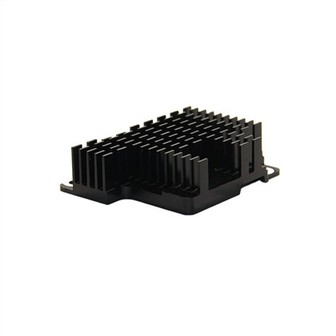
The design of the heat sink can also affect its performance. The most common designs are finned, folded, and pin fin types. Finned heat sinks have vertical or horizontal fins that increase the surface area and promote natural convection. Folded heat sinks have folded or zigzag-shaped fins that provide more surface area in a confined space. Pin fin heat sinks have densely packed pins or needles that maximize the contact area between the heat sink and the component.
Choosing the best Heat Sink
To select the best heat sink for your inverter, you need to consider several factors such as the power rating, thermal budget, ambient temperature, airflow, mounting options, and space constraints of your application.
The power rating of your inverter determines the amount of heat that needs to be dissipated. The larger the power rating, the greater the cooling requirement. You need to choose a heat sink that can handle the thermal load of your inverter without exceeding its maximum operating temperature.
The thermal budget is the temperature rise that your inverter can tolerate without affecting its performance or lifespan. You need to choose a heat sink that can keep the junction temperature of your inverter within the desired range under normal operating conditions.
The ambient temperature is the temperature of the surrounding air. You need to consider the worst-case scenario and choose a heat sink that can maintain the thermal performance of your inverter even under extreme temperatures.
The airflow is the amount of air that flows through the heat sink. You need to ensure that the heat sink can leverage the available airflow to enhance its cooling capacity. You may also need to consider using a fan or other active cooling solutions if the airflow is insufficient.
The mounting options and space constraints of your application can also affect the choice of your heat sink. You need to choose a heat sink that can fit in your available space and be mounted securely and easily.
Sinda Thermal is a leading thermal manufacturer in China, our factory was founded in 2014, and located in Dongguan city, China, we are offering varieties of heatsinks and other precious metal parts. Our plant possesses 30 sets advanced and high precious CNC machines and stamping machines, also we have many testing and experiment instruments and professional engineering team, so our company can manufacture and provide high quality products with high precision and excellent thermal performance. Sinda Thermal is commited to a range of heat sinks which are widely used in new power supply, New energy vehicles, Telecommunications, Servers, IGBT, and Madical. All the products accord with Rohs/Reach standard, and the factory is qualified by ISO9001 and ISO14001. Our company has been a partner with many customers for good quality, excellent service and competitive price. Sinda Thermal is a great heat sink manufacturer for the global customers .