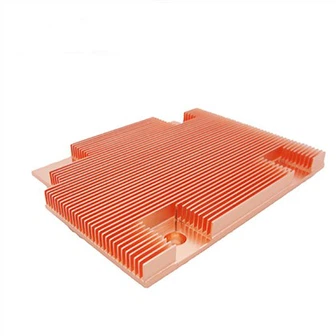
AI drives the cooling revolution, and 3D-VC is the key
Driven by the generative AI boom triggered by ChatGPT and the demand for high computing power in autonomous driving and big data model applications, the AI server market has maintained rapid growth. According to IDC data, the global AI server market will reach $15.6 billion in 2021 and $31.8 billion in 2025.

The power of the new generation of AI servers is increasing step by step, approaching the limit of air-cooling. AI server leader NVIDIA not only actively introduces liquid cooling solutions on its latest platform, but also configures 3D-VC (3D vapor chamber) heat dissipation on some AI GPU chips. NVIDIA typically has 4 to 8 GPUs per AI server, with each chip having a power output of up to 300W to 700W, which places high demands on heat dissipation solutions, leading to a shift in air cooling solutions from traditional flat VC to 3D-VC.

3D-VC is different from traditional vapor chamber . In traditional design, the vapor chamber is located at the top of the chip and transfers heat to multiple heat pipes for secondary assembly, which then transfer heat to the fin group. Due to the separate design of the soaking plate and heat pipe, the heat transfer distance increases and the thermal resistance increases.
3D-VC extends the heat pipe design to the body of the vapor chamber, where the vacuum chamber of the vapor chamber is connected to the heat pipe as a cavity. The working liquid reflux capillary structure of the heat pipe is also integrated with the connection of the vapor chamber, so the heat energy of the soaking plate is faster transferred to the heat pipe and then to the fin group.

Compared to traditional soaking plates, 3D-VC can dissipate more heat. In this way, with a smaller module size design, it can handle power exceeding 300W without causing excessive increase in server volume.
In addition, another important application of 3D-VC is high-end gaming graphics cards, which can cover up to 400W of NVIDIA RTX40 series or AMD RX70 series in terms of heat dissipation capability. With mainstream graphics card brands such as MSI increasingly favoring 3D-VC cooling solutions, 3D-VC has seen two major application advantages: AI servers and high-end graphics cards