Application classification of FPGA devices in medical field
FPGA (on-site editable gate array) is an important inventions of Xilinx, which is known for its programmable and flexibility. At first, FPGA was only used to simulate ASIC, and then the mask processing and batch manufacturing are used. However, ASIC is obviously too high in the customization of FPGA, and the cost is too small, so the two do not conflict. Then, as the accelerator has increased, it has become a parallel computing device with GPU.
Today, FPGA has developed data center field, compared to CPU and GPU, FPGA requires less device, and power consumption is better. The Saulith relies on its "Data Center Priority", "Accelerating Core Market Development", "Driving Adaptive Calculation", making its ACAP platform and Alveo acceleration cards in the data center market is very competitive.
In addition, Saulith has demonstrated the "Integrated Smartnic Platform" in its cloud service provider, the "FPGATCON" program in the consumer field, the ZynqSoc series of industrial fields.
In fact, according to the disclosure of Xilin, the medical field has occupied a very important specific gravity of Saulisan, and has been growing at 11% -15%. So, what is the medical market that relies on the medical market that is occupied by FPGA products, what role does the FPGA device play in medical equipment?
A few days ago, Sainger introduced the reporter to the recent results in medical science and medical equipment, and 21 Chinese electronic network reporters were invited to participate in this interview.
Where can FPGA devices?
Information shows that the global per capita medical expenditure is growing every year. With the aging aging, consumers have extremely high expectations for medical conditions and medical costs. On the other hand, with the outbreak of the epidemic, the market has higher requirements for the rapid analysis of the disease and the rapid analysis of the diagnosis, which requires the further reduction of medical device costs and improvement.
The FPGA device itself has programmable characteristics, with this advantage, avoids high-level disposable project fees in the previous period of ASIC devices, eliminating minimum order quantity and multi-chip iterative risk and loss. The medical industry itself is one of the most closely connected industries with technology development. With the continuous iteration upgrade of the FPGA device, more new equipment has led new treatment, treatment pathways, and changes in treatment.
According to Subhbhattacharya, Xilinx's FPGA device in medical field is mainly divided into three categories: clinical, medical imaging and diagnostic analysis.
01, clinical environment
The number of clinical devices is large, and therefore the FPGA with strong flexibility is required. It should be noted that some devices directly affect the patient's life safety, the start speed, safety stability, and the time delay is extremely high; some equipment has certain requirements in portability, with great demand for power consumption, small size.
According to SUBH, in the clinical aspect, Xilinx's Zynqultrascale + MPSOC (hereinafter referred to as "ZU + MPSOC") is a highly integrated platform, integrated multiple processors, programmable logic, and also integrate information security And functional security features. SUBH emphasizes that the powerful function and performance of this technology platform is ideal for clinical environment applications, including from the cloud to the edge.
02, medical imaging
Large medical imaging devices use FPGA devices. Subh is a reporter introduced that in terms of medical imaging, mainly include CT, ultrasound, X-rays, PET, MRI scanners, etc.
For medical imaging, Zynqultrascale + MPSOC is equally applicable. SUBH, in addition to this, there is VersaCap, which is understood to be a next-generation MPSOC, Versalacap has a very advantage in the imaging field.
In addition to the ARM multiprocessor integration, programmable logic, DSP, VERSALACAP has also added a unit of AI engine, named, and VLIW, can support a number of similar operations.
SUBH shows the reporter showing the program of ultrasonic image reconstruction and computer-aided diagnosis, using the hardware and software support of Xilinx, can reduce power consumption and thermal range, reduce solution cost, extend equipment life, low delay edge inferior, though The market is very complicated, and the technology of Xilinx can greatly improve productivity.
03, diagnostic analysis
SUBH said that in addition to SOC and FPGA, Saili also provides plug-and-play Alveo Acceleration Card, which is a PCLE solution, so it can greatly reduce the development time. According to this, the Alveo Acceleration Card is suitable for any universal PC, which can accelerate the normal task of the CPU, or can accelerate other GPU tasks, ultimately high throughput and ultra-low delay. Its unique power and flexible strain ability can greatly accelerate a lot of medical applications.
United Medical (United States) is a Chinese company that discovered that Alveo's technical cost is lower and low, and there is no need to sacrifice any performance or development.
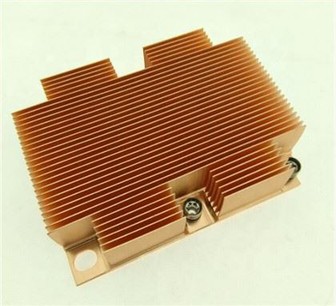
Thermal solutions for every industry is very important as the power is gradually higher and higher, Sinda Thermal can provide varieties heatsinks and coolers which inlcuding aluminum extruded heatsink, high performance heatsink, copper heatsink, skived fin heatsink, and heat pipe heatsink. please contact us if you have any questions about thermal solution.
website: www.sindathermal.com
contact:castio_ou@sindathermal.com
Wechat: +8618813908426