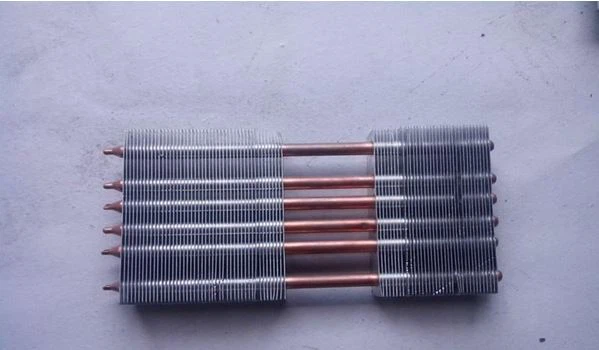
Application of heat pipe technology in data center cooling system
With the advancement of science and technology, the IT equipment in the computer room of the electronic information system is highly integrated, and its energy efficiency deviation and the increasing heat dissipation of the computer room have begun to receive strong attention from the industry. According to the statistics of authoritative departments, my country's high-end server-concentrated communication industry consumes electricity In 2007, it has reached more than 20 billion kW·h, and the information industry has become a high energy consumption industry.
As a functional space, data centers contain data servers, computing equipment, air-conditioning systems, and electrical equipment that consume a lot of energy during operation. Air-conditioning systems in particular account for 40% of the total energy consumption of data centers. According to the latest energy statistics, the world is currently The total power consumption of the data center has accounted for 3% of the global power consumption. Therefore, reducing the energy consumption of the data center cooling system and changing the current high energy consumption mode has become an urgent problem for current data center operators.
2.Introduction to heat pipe technology of data center cooling system
2.1 Heat pipe structure
Commonly used heat pipes are composed of three parts: the main body is a closed metal tube (including the tube wall and end cap), and there is a small amount of working medium (working fluid) and capillary structure (tube core) in the internal cavity; according to whether it has a capillary structure The heat pipe can be divided into a gravity-assisted heat pipe and a capillary heat pipe. According to the required working temperature, different types of working fluids can be selected for the heat pipe, such as water, acetone, methanol or refrigerant, etc.
2.2 Working principle of heat pipe
When one end of the heat pipe is heated, the liquid in the capillary wick evaporates and vaporizes. The steam flows to the other end under a slight pressure difference and releases heat to condense into a liquid. The liquid flows back to the evaporation section along the porous material by the action of capillary force. In this way, the heat is circulated. Pass from one end to the other.
In this heat transfer process, the following six interrelated processes are specifically included: heat is transferred from the heat source through the heat pipe wall and the wick filled with working fluid to the liquid-gas interface in the evaporation section; the liquid is evaporating Evaporates at the liquid-gas interface of the condensing section; the steam in the steam chamber flows from the evaporation section to the condensing section; the steam condenses on the liquid-gas interface in the condensing section; heat passes through the liquid-gas interface from the liquid-gas interface in the condensing section. The core, liquid and tube wall are transmitted to the cold source; in the wick, due to capillary force (or gravity), the condensed working liquid flows back to the evaporation section.
Existing heat pipe technology can help data centers save energy and reduce consumption, and has many advantages, but there are still the following problems: the combination of existing round heat pipes and the outer surface of IT equipment is a difficult problem; the heat released by the condensation end of the heat pipe is still discharged into the data In the internal space of the center, the cooling load in the data center has not been reduced, and it still needs to be cooled by air-conditioning, which does not achieve the effect of energy saving and emission reduction. Some heat pipes require external power to drive.
In response to the above problems, a micro-channel flat loop heat pipe system based on data center cooling and waste heat recovery is proposed. This system has the following advantages: The flat heat pipe can be closely attached to the outer surface of the IT equipment, which is beneficial to enhance the heat transfer effect. The evaporating end and the condensing end are connected by a steam transfer pipe and a liquid return pipe to form a microchannel flat loop heat pipe system. The condensing end can be placed outside the data center, thereby reducing the cooling load of the internal space of the data center; the heat of the condensing end can also be reduced.
As the heat source of domestic hot water, it recovers the heat emitted by the data center server to achieve the purpose of energy saving and emission reduction; the entire system uses gravity and the capillary force provided by the micro-channel capillary structure for heat transfer cycle, without any external force driving.
Developed a micro-channel flat loop heat pipe based on the data center waste heat recovery system, suitable for high heat density electronics and high-power high-frequency switching power supply equipment. The flat heat pipe is closely attached to the IT equipment. The heat is transferred to the heat pipe, and the heat pipe transfers the heat to the condensing end through the internal working fluid for heat dissipation. The rack does not need to reserve convection heat dissipation space; it will effectively increase the use space of the rack, and the number of IT equipment in the rack can be appropriately increased. Increase rack density and reduce data center construction costs; it can also improve equipment operating efficiency and safety, realize efficient heat dissipation and waste heat recovery and reuse of equipment, and provide support for the development of energy-saving and emission-reduction technologies for data center buildings. It has important application value and Significant energy saving benefits.