Comparison Of Heatpipes and vapor chambers
Heat pipe and vapor chamber are widely used in high-power or highly integrated electronic products. When used properly, it can be simply understood as a component with very high thermal conductivity. It is not difficult to understand that heat pipe and VC can effectively eliminate diffusion thermal resistance.

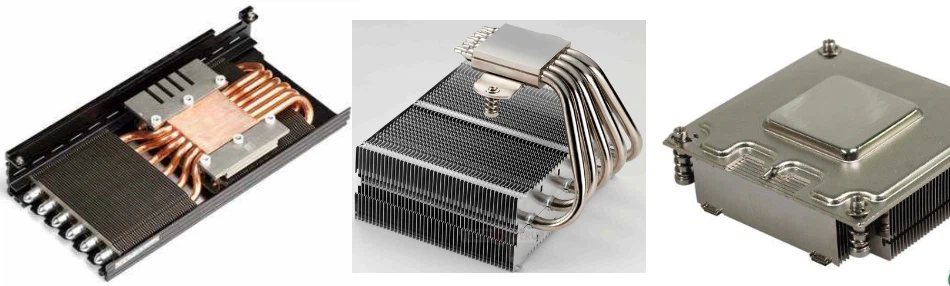
The most common application example of heat pipe is embedded in the heatsink to fully spread the heat of the chip on the heatsink base or fins. When the heat emitted by the chip is transferred to the heatsink through the thermal conductive interface material, the heat can propagate along the heat pipe with very low thermal resistance due to the high thermal conductivity of the heat pipe. At this time, the heat pipe is connected with the radiator fins, and the heat can be more effectively lost to the air through the whole radiator. When the heating area of the chip is relatively small, it will be directly transmitted to the substrate of the radiator, which will make the substrate temperature distribution have great non-uniformity. After installing the heat pipe, due to the high thermal conductivity of the heat pipe, it can effectively alleviate the non-uniformity of temperature and improve the heat dissipation efficiency of the heatsink.

Another application of heat pipe is efficient heat transfer. This design is very common in notebooks. The specific design reason is that when the chip is heated, there is not enough space to install the heatsink, and there is relevant space to install the heat dissipation strengthening parts in the other distance of the product. At this time, the heat emitted by the chip can be transferred to a suitable space for heat dissipation with a heat pipe.

The use of VC heatsink is relatively simple, because the vapor chamber can not bend flexibly like heat pipe. However, when the heat of the chip is very concentrated, the advantages of the VC can be reflected. This is because the vpaor chamber is similar to a "flattened" heat pipe, which can distribute the heat evenly to the whole plate surface very smoothly. In the design of heat pipe inlaid substrate, those "blind areas" not covered by heat pipe will still have large diffusion thermal resistance.
When the chip heat is very concentrated, these blind areas sometimes lead to very obvious temperature difference. At this time, if the vapor chamber is used, these blind areas will be eliminated, the whole substrate of the heatsink will be completely covered, and the diffusion thermal resistance will be weakened more effectively, so as to improve the heat dissipation efficiency of the heatsink.

Heat pipe and VC are highly technical materials in heat dissipation components. The design and selection of heat pipe and VC also involves more in-depth thermal design knowledge, which needs to be carefully considered in combination with requirements and application scenarios. When the type selection is not appropriate, the heat pipe and VC can not only strengthen the heat exchange, but also form a great thermal resistance, resulting in the failure of the thermal solution.