How does Cold Spray Technology application in heatsink production
Electronic devices generate heat during operation, leading to a decrease in performance and reliability. IC components with higher thermal power consumption typically rely on heat sinks to conduct heat and avoid junction temperatures exceeding the maximum allowable limit. Installing a heat sink on a silicon based semiconductor chip and ultimately dissipating the heat of the chip through air or liquid is a common cooling method for electronic devices. These radiators are usually processed separately using copper or aluminum materials, or a combination of copper and aluminum materials.

Copper has a higher thermal conductivity than aluminum, and its heat dissipation capacity per unit volume is superior to aluminum. Excluding the influence of weight and cost, copper is the preferred material for heat sinks. Aluminum materials have low thermal conductivity, so aluminum radiators cannot dissipate heat quickly enough, requiring larger surface area and higher fins. In many compact applications, especially in systems that pursue high power density, aluminum radiators are not the best choice.

The heat sink includes a base that comes into contact with the heat source chip, as well as fins connected above the base through manufacturing methods such as stamping, welding, extrusion, tooth cutting, and chipping. The base contacts the chip, absorbs the heat from the chip and conducts it to the fins. The fins try to increase the surface area as much as possible, accelerate the air heat exchange efficiency, and ultimately take away the heat from the chip. High power electronic devices often generate heat quickly on chips. If the heat sink is an aluminum base, the heat transfer speed of the base may not be sufficient to quickly diffuse heat to the surface of the fins, resulting in increased heat resistance and insufficient cooling performance of the heat sink.
The entire or partial area of the aluminum radiator base can be replaced with copper material with better thermal conductivity to solve the problem of insufficient heat diffusion speed. This composite heat sink base uses copper to quickly conduct chip heat, while the fins are still made of aluminum, which can achieve both rapid thermal diffusion and cost-effectiveness.

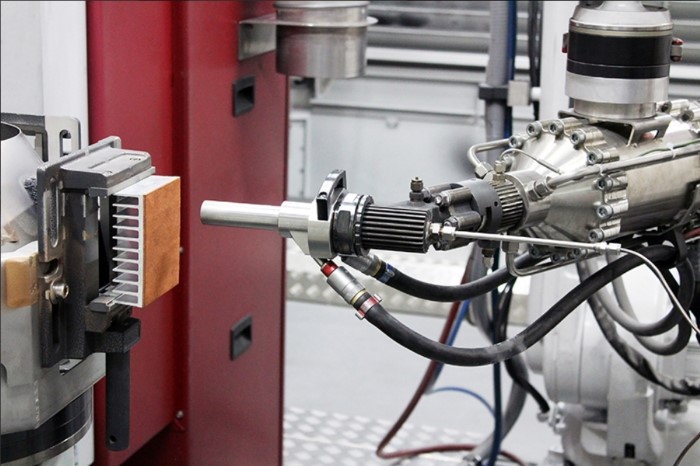
Cold Spray technology is a highly innovative surface coating and additive manufacturing process that can be used to connect copper and aluminum and overcome problems related to bonding welding and brazing. The cold spraying process can deposit powder particles in a solid state on the surface of the substrate at temperatures far below the melting point of the material, thus avoiding common problems caused by high temperature, such as high-temperature oxidation, thermal stress, and micro phase transformation. Cold spraying is a powder based processing technology where micron sized powder particles are accelerated by supersonic compressed gas in the nozzle, causing high-speed powder particles to collide with the substrate, causing plastic deformation and bonding with the substrate. The CS process has a shorter production time and allows for flexible selection of large-scale or localized deposition construction.

As is well known, heat sink performance is usually quantified based on thermal resistance values. Thermal resistance is a measure of the temperature at the top of the radiator above the ambient temperature for each unit of power dissipated by the radiator. The lower the thermal resistance value, the lower the temperature at the top of the fins in the same cooling environment, and the better the cooling performance of the radiator. The production cost of cold spray manufacturing composite radiators is slightly higher than that of aluminum radiators, but the weight and cost are lower than copper radiators. Adding a layer of copper to an aluminum radiator has a direct impact on production costs, but the benefit is that it will reduce the thermal resistance of the radiator by 48%.