How does liquid cooling technology affects data centers
With the reconstruction of production and life through technologies such as the Internet of Things and artificial intelligence, data is also accumulating and growing at an unprecedented speed. The diversity of data sources, complexity of formats, and uncertainty of semantics will all lead to higher performance requirements for IT equipment such as servers in data centers. As a result, data centers have also generated new demands for refrigeration technology. The efficient refrigeration effect of liquid cooling technology effectively improves the efficiency and stability of server usage, while allowing data centers to deploy more servers per unit space, improving data center computational efficiency. In the following text, the editor will take you to a detailed understanding of the impact of liquid cooling technology on data centers.

Due to the use of coolant and working fluid in liquid cooling technology to cool heating equipment and devices, there is no need for refrigeration units and end air conditioning in data center data centers, nor is there a need for server fans. Liquid is used instead of air, improving heat dissipation efficiency. The liquid conduction thermal energy effect and large specific heat capacity can ensure that the CPU operates at a certain range of overclocking without overheating faults. At the same time, the construction of air conditioning systems and corresponding infrastructure in liquid cooled data centers saves a lot of space and can accommodate more servers.

Accrding to the research on liquid cooled data centers, it has been concluded that traditional air cooling and emerging liquid cooling temperature control methods will coexist for a long time. Moreover, since liquid cooling does not have to be chosen for PUE and operating costs in cold weather areas, it can be completely built or expanded according to business needs, with greater development potential.
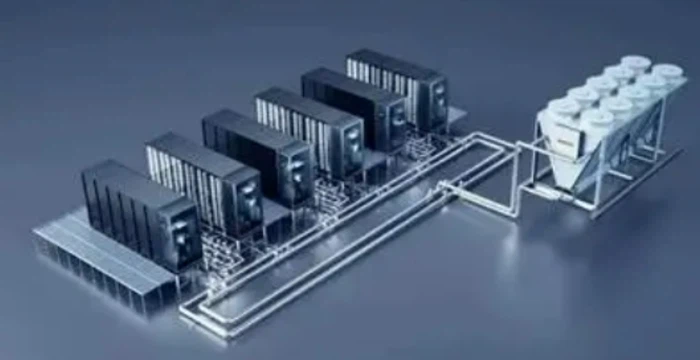
Given the same demand, it is suitable to use liquid cooling solutions for newly built data centers due to limited restrictions and policy support. Expanding the data center requires selecting an appropriate proportion of space compatible with liquid cooling to improve overall operational efficiency. The renovation of the data center requires reinforcement of the computer room based on the load-bearing capacity of the floor slab and the actual situation, leaving a moderate margin for liquid cooling.

The operation and maintenance cycle of liquid cooled data centers is generally 3 to 5 times that of traditional data centers, and the noise from fans is removed, making the working environment more user-friendly for operation and maintenance personnel. The way to solve the performance bottleneck of IT equipment is to systematically transform the cooling methods of data center servers and even the entire data center architecture. Using liquid cooling for cooling, with its cost and efficiency advantages, will support data centers to quickly adapt to the trend of improving IT equipment performance.