How to change 5G infrastructure game rules for high precision
As a four consecutive year, it is important for the important basic technology of "New Branch", 5G in expanding connection, driving economic growth, improve people's quality of life, and accelerating digital transformation and upgrading related industries. Combo.
According to IHS Markit independent research, "5G Economic" report is updated in 2020, it is expected that by 2035, 5G will create a global economic output of $ 13.1 trillion, and 5G capital expenditures and R & D investment will increase by 10.8%, annual investment. 265 billion US dollars.
The latest data from the Ministry of Industry and Information Technology, due to the end of 2020, China added 500,000 new base stations, promoting 330,000 shared sharing of 5G base stations, and the "5G coverage" in the beginning of the year has been implemented.
The global 5G connections will exceed 1 billion in 2023, which is ahead of the 4G era to achieve a total of 1 billion connections in advance. It can be seen that although the global economy is affected by the epidemic, the growth trend of 5G empowerment economic output is almost unchanged.
Interpretation of 5G's angle, but today we want to talk from the clock called "electronic system heartbeat".
"Clock IC" is a general term for describing an integrated circuit that can be generated, modulated, manipulated, distributed, or controls timing signals in an electronic system. When applied in the current most advanced electronic and communication systems, the clock IC must also generate precise clock pulses and continuously distribute the signal to the system to meet multiple types of application pairs. The need for accuracy tutorial.
In fact, the 4G / 5G communication system we are familiar with is one of the important application scenarios of "high-precision tutorial". Since the 4G / 5G network uses TDD time division multiplexing mode, during a large rate data transmission, the time synchronization accuracy is extremely high, for example, TDD measuring time synchronization represented by TD-LTE is ± 1.5 μs. If the time between communication devices is not synchronized, it will affect the normal operation of the communication service such as base station switching and roaming.
How is the 5G award?
The main source of the accurate time of wireless communication networks has always been the Global Positioning System (GPS) and regional satellite constellations constituting the Global Navigation Satellite System (GNSS). Among them, GPS is the satellite constellation of the world's first deployment, navigation and timing (PNT). With carefully designed GPS timing receiver technology, GPS users can restore extremely precise timing from synchronous atomic clocks on GPS satellites.
Currently, in addition to GPS, a number of GNSS technologies for timing are also deployed worldwide, including Galileo (EU) and Beidou (China). As an example of North Dan, the time of the Beidou satellite navigation system is called BDT. When the atom can be traceable to the Coordination of China National Time Center, the UTC, and the time difference control accuracy of UTC is less than 100 ns.
Strong GNSS, there is a short board
Although GNSS satellite is more accurate, it is more capable, but it is also facing huge risks - if the interference, deception, fault, or other incident leads to GPS / GNSS unused, service interruption will cause catastrophicity to system performance. Impact. Just as the power grid is affected by fire / snow disaster, the 5G network is also very susceptible to the impact of accurate time distribution interruption, and may even lead to the entire system.
In addition, from the high-band wide video transmission of smartphones, to the Internet of Things (IoT) of the automatic driving, smart cities, and smart factories, the huge capacity and bandwidth growth brought by 5G mobile networks is before they cannot be imagined. These new services not only depends on a large number of sensors, base stations and other devices, but also need to deliver very accurate time on long distances, causing 5G network endpoint density and relying on GPS / GNSS to take time the cost is getting higher and higher.
New Time Distribution Architecture
Operators urgently need to reduce even eliminate solutions for GPS / GNSS dependencies. Then there is a new type of time allocation architecture that allows operators to protect their mobile networks from the GNSS interruption, and allocate exact times in long distance to cover the whole country, but also provide the necessary performance to meet 5G End to the end budget?
The answer is yes.
The enhanced PRTC (EPRTC) standard is ideal for responding to the new type of timeline architecture. It is one of several versions of the main reference clock (PRTC) defined by ITU-T (ITU Telecommunications Standardization Department) to improve time accuracy. The PRTC A category can meet 100 NS (nanoseconds) accuracy requirements relative to coordination world (UTC); PRTC B is more accurate, accurate up to 40 ns; enhanced PRTC has 30 ns defined by ITU-T G.8272.1 Accuracy.
The unique design of EPRTC makes it maximum elasticity, which can be used as a reference clock for 14 days or longer, while maintaining the maximum deviation of UTC over a long period of time at 100 NS, which will become 5G mobile operators. The key advantage of deploying EPRTC. If GPS is closed, service delivery within the entire network will remain seamless to ensure that the required time is fixed to keep the GPS interrupt or remain operation in the case where GPS is not available.
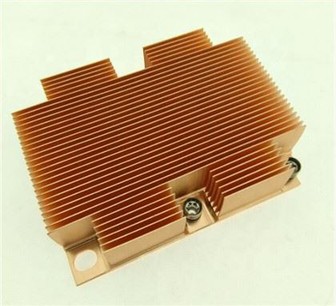
Thermal solutions for every industry is very important as the power is gradually higher and higher, Sinda Thermal can provide varieties heatsinks and coolers which inlcuding aluminum extruded heatsink, high performance heatsink, copper heatsink, skived fin heatsink, and heat pipe heatsink. please contact us if you have any questions about thermal solution.
website: www.sindathermal.com
contact:castio_ou@sindathermal.com
Wechat: +8618813908426