How to choose a computer radiator for novices? It turned out to be so simple!
The better the CPU, the smoother and more usable the computer, but it also generates more heat. The computer radiator is an important helper to help the CPU dissipate heat.
When we are playing games and rendering large-scale 3D programs, the fully-fired CPU will overheat, which will reduce the frequency, causing dropped frames and freezes, which greatly affects the daily experience. For example, the temperature wall set by Intel CPU is 100°C, and the frequency will be automatically reduced when the temperature exceeds the specified temperature.
So how can noobs choose an easy-to-use computer radiator?
1.Look at the heat pipe first
As the name implies, a heat pipe is a channel for conducting heat. Generally speaking, the more heat pipes and the thicker the heat pipes (mainstream heat pipes are generally 6mm), the better the heat dissipation effect. However, the price will also become higher, and friends can choose according to their needs.
For students who are just home and office, choosing 2 heat pipes is enough. At present, 4 heat pipes are suitable for most people's needs, and games and office can meet the needs. For high-end players and those who like to overclock, it is recommended to choose 6 heat pipes or more, depending on your budget.
2.Material of heat pipe
In addition to the number and thickness of the heat pipes, the heat pipes of the radiator are also divided into non-nickel-plated and nickel-plated heat pipes. The difference between the two lies in price and longevity. The non-nickel-plated radiator has no coating to protect the copper tube, so it shows its true color and the price is more cost-effective.
The nickel-plated copper tube, because of the nickel alloy coating, presents a shiny silver, has a good anti-rust and anti-corrosion effect, so it has a longer life, but the price is higher, but the heat dissipation efficiency is almost the same. It depends on everyone's budget.
The main cost-effective scythe Chituma is equipped with 4 6mm thick copper tubes and nickel plating treatment, which not only has excellent heat dissipation effect, but also is more durable and has a longer life.
3.Look at the cooling base
The cooling base will directly contact our CPU, and conduct the heat generated by the CPU to the radiator. Therefore, the heat dissipation base needs to be tightly attached to the CPU, which requires a high level of smoothness and flatness.
At present, there are two mainstream heat pipe direct contact and copper bottom welding. The heat pipe direct touch is suitable for most people. Its principle is to directly squash the heat pipe on the base and polish it to achieve flatness. The process is simpler, so the price is very cheap and the heat dissipation effect is relatively good.
The copper bottom welding is to polish the copper base very smoothly, with better flatness and better heat dissipation effect. However, because of the higher process and cost, the price is higher, and it is more suitable for high-end enthusiasts.
The entry-level radiator launched by the big cooling brand Cooler Master, T410R is not only excellent in appearance, but also provides 4 6mm thick heat pipes and exquisite heat pipe direct contact 2.0 technology, making the base very flat and the heat dissipation effect is very good.
4.Cooling fins
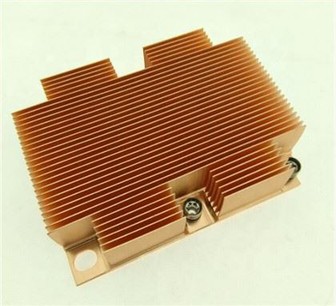
The role of the cooling fins is to dissipate the heat generated by the CPU work into the air with the help of the fan, which is the last step of the entire heat dissipation process. On the premise that the fan speed is fast enough, the larger the heat sink fins, the better.
The heat sink fins also have different design methods, mainly through FIN (through chip) process and reflow soldering process. Wearing the FIN process refers to inserting the heat pipe into the fin, which is a very test of workmanship, is cheap, and the heat dissipation effect is relatively good, but if the workmanship is not good, it may become loose and poorly contacted, which affects heat dissipation.
The reflow soldering process mainly appears on high-end radiators. It fixes the heat pipe and fins together by welding, and the identification method is relatively simple. There will be some small holes beside the top heat pipe. It has better heat dissipation efficiency and is stronger, but it is more expensive and not suitable for ordinary consumers.
The large heat dissipation fins, plus the exquisite FIN process, combined with 6 heat dissipation copper pipes, and the copper bottom welding process, bring excellent heat dissipation efficiency, making the Kyushu Fengshen Dashuang Tower very popular with everyone.