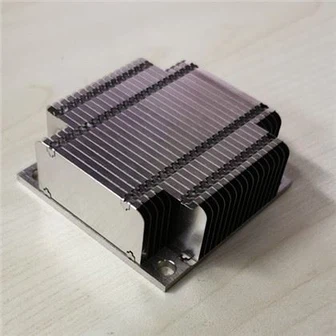
Introduction of aluminum profiles and aluminum alloy die castings
At present, the commonly used radiator designs on the market include aluminum profiles and aluminum alloy die castings.
Common aluminum profiles are as follows:

Features of aluminum profile:
1. Corrosion resistance The density of aluminum profile is only 2.7g/cm3, which is about 1/3 of the density of steel, copper or brass (7.83g/cm3 and 8.93g/cm3, respectively). Under most environmental conditions, including air, water (or salt water), petrochemicals and many chemical systems, aluminum can show excellent corrosion resistance.
2. Conductivity Aluminum profile is often selected because of its excellent electrical conductivity. On the basis of equal weight, the conductivity of aluminum is nearly twice that of copper.
3. Thermal conductivity The thermal conductivity of aluminum alloy is about 50-60% of copper, which is beneficial to the manufacture of heat exchangers, evaporators, heating appliances, cooking utensils, and automobile cylinder heads and radiators.
4. Non-ferromagnetic Aluminum profiles are non-ferromagnetic, which is an important feature for the electrical and electronic industries. Aluminum profiles are not spontaneously combustible, which is important for applications involving handling or contact with flammable and explosive materials.
5. Machinability The machinability of the aluminum profile is excellent. In various deformed aluminum alloys and cast aluminum alloys, as well as in the various states these alloys have after being produced, the machining characteristics change considerably, which requires special machine tools or technology.
6. Formability The specific tensile strength, yield strength, ductility and corresponding work hardening rate dominate the change in allowable deformation.
7. Recyclability Aluminum has extremely high recyclability, and the characteristics of recycled aluminum are almost indistinguishable from primary aluminum.
These characteristics of aluminum profile are important reasons why it can be used as a radiator.
Common aluminum alloy die castings are as follows:

Die castability of aluminum alloy:
一. There are many aluminum alloys used for die-casting, and each aluminum alloy has different die-casting properties. A reasonable die-casting aluminum alloy should have the following conditions:
1. Low melting point: reduce the temperature difference with the mold.
2. Good fluidity: improve the filling capacity during die casting.
3. Small thermal expansion coefficient: reduce shrinkage.
4. Low temperature brittleness: avoid high temperature cracking.
5. The affinity with the mold should be low: avoid mold sticking, and the iron content should not be too high.
6. Low melt oxidation: If the melt is easy to oxidize, the fluidity will be reduced.
7. Small casting stress: avoid deformation and affect strength.
二. The role of elements in die-cast aluminum alloy:
1. Silicon (Si): It mainly improves the fluidity of die-cast aluminum alloy. At the eutectic point (12.5%), the fluidity of aluminum alloy is the best. The high content of silicon in the aluminum alloy has good flow properties, but the highest is 12.5%. At the same time, the high content of silicon results in less shrinkage. However, the higher the silicon content, the more brittle the aluminum alloy and the more difficult it is to cut. The main reason for the good toughness, easy processing and oxidation of processed aluminum alloy is the effect of silicon.
2. Copper (Cu): Mainly used to enhance the mechanical strength and corrosion resistance of aluminum alloys. The increase of copper in the aluminum alloy will reduce the die casting performance, but the corrosion resistance to the crucible will be reduced.
3. Magnesium (Mg): It is mainly used to increase the tensile strength, hardness, and corrosion resistance, and can improve the performance of the anodic oxide film, but the increase of magnesium will increase the hot cracking property and reduce the die-casting performance.
4. Iron (Fe): The main function of iron is to reduce the sticking of the mold. In order to make it easier to mold out, it is better to contain 0.8-1.0% iron in the alloy. However, if the iron content is too high, hard spots will be produced, which will lead to tool wear and tool collapse during processing.