Introduction to types of graphics card heatsinks
As the most power consuming accessory in the current PC platform, the calorific value of graphics card can not be underestimated, and manufacturers will design appropriate heatsink solution for different customers' products. Therefore, it is most appropriate to balance the thermal performance and the manufacturing cost when selecting an appropriate thermal solution for the graphics card.

Extrusion Fan cooler:
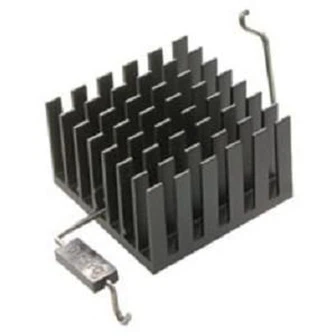
This is the simplest kind of heatsink. The whole piece of metal is used for certain aluminum extrusion processing. The cutting shapes are also various, including parallel fins like grids and radial circular fins. Metal block cutting radiators were common in early graphics cards. Now, with the progress of processing technology, only a few graphics cards with low calorific value can be used. Since the power consumption of graphics cards with this thermal performance is generally low and the heat dissipation is small, most of them do not connect external fans. They directly adopt this passive thermal cooling solution. For this kind of heatsink, the larger the hetasink, the larger the cooling area, The better the heat dissipation effect.

Copper base +Zipper fin +Vortex fan:
This heatsink design generally adopts the combination of copper base and aluminum fins. The advantage lies in the application of fins, which greatly enhances the actual cooling area. At the same time, because the fins and the base are also connected by welding, the direction of the fins is too complex. When relying on the operation of the turbofan, the air flow is drawn from the fan, and then the fan blade blows out the direction of the air duct specified in the wind direction to form a high-speed air flow and bring out the heat quickly.

Heatpipe and fin stack soldeing module :
The combination of heat pipe and fin stack is used on this solution for high performance graphics card cooling . The fin area in this mode is larger than that in the previous one, and because the heat conduction is carried out through the heat pipe, the restrictions on the shape and size of the fin are also weakened. The thickness of fins is very thin, and aluminum is usually used as the material. Some even process many protrusions on the fins to further increase the cooling area. At the same time, the heat transfer efficiency of the heat pipe is much higher than that of pure aluminum. Through the special fin threading process, the heat of the core can be quickly transferred to the aluminum fins and then taken away by the fan.

Liquid cooling solution:
The liquid cooling mode integrates the advantages of all therma lsolutions, it has better heat dissipation effect and no noise. However, due to the large number of heat dissipation components and large space, the chassis must also be expanded, so the cost is relatively high.

Due to the continuous rise of the working frequency of the core of the graphics card and the working frequency of the graphics memory, the heating capacity of the graphics card chip is also increasing rapidly. The number of transistors in the display chip has reached or even exceeded the number in the CPU. Such a high degree of integration will inevitably lead to an increase in calorific value. In order to solve these problems, excellent thermal solution is the necessary item for selecting the graphics card.