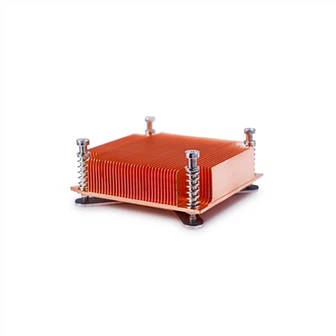
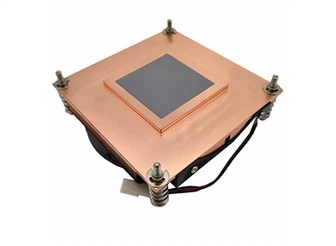
The structure and working principle of 3DVC
A heat pipe is a one-dimensional thermal conductive element that conducts heat from one end of the pipe to the other. VC (heating plate) is a two-dimensional thermal conductive element that conducts heat from a point to a surface. 3D-VC, as the name suggests, not only allows for thermal conduction in the X and Y plane directions, but also adds a one-dimensional thermal conduction in the Z direction. Its principle is like a two-dimensional VC+a one-dimensional heat pipe. The core feature of 3DVC is that the internal cavity is conductive in all directions, and the capillary structures in all directions are also connected together. He has a fundamental difference from welding heat pipes on a conventional temperature equalization plate.

The manufacturing process of 3DVC is quite complex, equivalent to making heat pipes and VC, and then welding the two together, with the internal cavity conducting and ensuring sealing. Due to the high size of the product in the Y direction, the welding capacity is very low and the price is expensive. The current mainstream method is to use solder paste to weld the heat pipe and VC top cover, then sinter the capillary structure, add support structure, and weld the top and bottom covers. The subsequent process is the same as conventional VC.

It is also possible to use an integrated upper cover (by forging or other methods to obtain the Y-direction heat pipe shell and the VC upper cover shell integrated into shape). This process also has significant limitations and high investment costs, and has not been widely adopted. The difficulty in making 3DVC lies in the multiple connection positions and high sealing requirements; The capillary structure should be connected together to ensure smooth liquid reflux channels. Introducing a suction core can to some extent increase the effect of liquid reflux.

The vapor chamber itself is a fast thermal conductivity element; Before the generation of 3DVC, the main method was to use overheat tubes to quickly transfer heat from the BASE to each cooling plate. There is still contact thermal resistance between the BASE and the heat pipe, as well as the thermal resistance of the copper material itself. Without introducing external moving components to enhance heat dissipation, 3D VC utilizes the principle of phase change heat transfer through thermal diffusion in a three-dimensional structure to directly and efficiently transfer heat from the chip to the far end of the tooth for heat dissipation. It has the advantages of efficient heat dissipation, uniform temperature distribution, and reduced hotspots, which can meet the bottleneck requirements of high-power device heat dissipation and uniform temperature in high heat flux density areas.