Thermal design challenges of military equipment
The working environment of military equipment is complicated
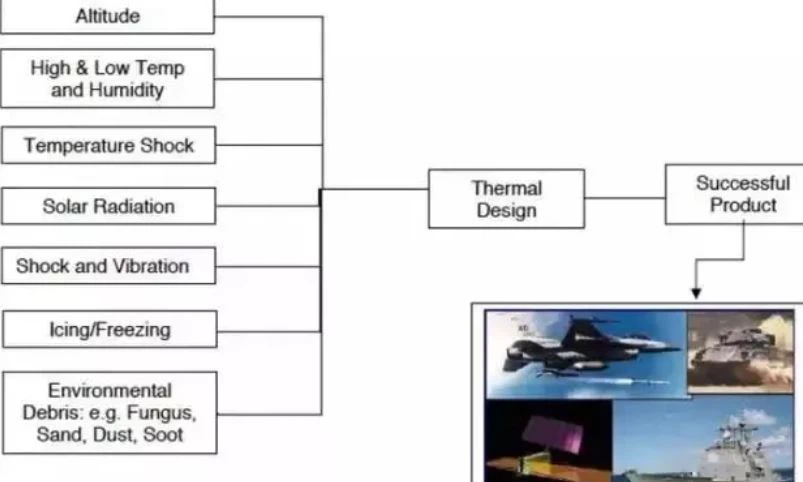
Altitude, high temperature, low temperature, humidity, temperature shock, solar thermal radiation, shock vibration, icing, various harsh environments (fungus, desert, dust, soot, etc.) all have different degrees of influence on its thermal design. In addition to complex boundary conditions, the biggest challenge in the thermal management of electronic products in the defense industry is the short-term thermal shock.
These electronic products are often exposed to an extreme thermal environment. Suppose a jet fighter parked in the Caribbean Sea is now going to perform a mission. The aircraft is at sea level at this time, and the temperature and humidity are very suitable. When the aircraft takes off, it will be in a high-altitude, below-freezing temperature environment, and the boundary conditions of electronic products will be changed within minutes or even seconds. Therefore, the electronic products in the aircraft must be able to operate in a wide range of ambient temperatures Work.
The following picture shows the role of thermal design in a successful electronic product and the impact of the environment on it. It can be seen that altitude, high temperature, low temperature, humidity, temperature shock, solar thermal radiation, shock vibration, icing, and various harsh environments (Fungus, desert, dust, soot, etc.) all have varying degrees of influence on thermal design.
Process a lot of data and generate more heat
Due to the nature of military tasks, these electronic products will inevitably cause these electronic products to undertake a larger amount of data processing, and at the same time require faster data processing speeds, and the heat consumption of electronic products will increase sharply. Therefore, the harsh environmental conditions and the rapidly increasing heat consumption of chips make the thermal management of electronic products in the defense industry face huge challenges. Lightweight and perfect reliability increase the difficulty of thermal design
For electronic equipment in the atmosphere or outer space environment, weight is a very important element. The lighter the weight, the longer the product will continue to work, and the lower the cost. Obviously, due to the existing characteristics of jet fighters, missiles, tanks, etc., electronic products are in a harsh thermal environment, so the thermal reliability of electronic products in the defense industry is a very important factor.
Thermal design of military equipment
Due to the high heat consumption of military electronic products and the harsh working environment, they usually present a higher heat flow. Similar to other electronic products, they must have a good cooling system, and the space size, weight, heat consumption, and heat consumption of the equipment must be considered. Electromagnetic shielding and other requirements.
Normal electronic systems tend to be designed as closed enclosures, and most electronic products are isolated from the cooling system as much as possible. Imagine a Hummer Mercedes-Benz in the desert. If the electronic products are not hermetically sealed, the various working environments such as sand, debris, etc., will paralyze the electronic products.
At present, many engineers prefer to use hybrid cooling methods for thermal design of electronic products. Most electronic chips use air-cooled heat dissipation, and water-cooled heat dissipation devices are used for devices that consume a lot of heat. But for electronic devices in space flight or outer space, this kind of heat dissipation method is not advisable, and a more compact liquid cooling system must be designed.
For example, the use of high thermal conductivity substrate materials, VC uniform temperature plates, heat pipes, TEC embedded in the die, jet cooling or direct immersion liquid cooling, so that heat can be transferred to the liquid, and then to the liquid cooling system In the heat exchanger. As shown in the figure below: