Thermal management in Power Supply
When referring to the word "power management", most people will think of MOS tubes, converters, transformers, etc. In fact, power management is much more than that. The power supply will generate heat during operation, and the continuous temperature rise will cause performance changes, which may eventually lead to system failure; In addition, heat will also shorten the service life of components and affect long-term reliability. Therefore, power management also involves thermal management.
About thermal management , there are microcosmic and macroscopic parts:
Microcosmic :
A single component is overheated due to excessive heating, but the temperature of the rest of the system and the shell is within the limit.
Macroscopic:
The temperature of the whole system is too high due to the heat accumulation of multiple heat sources.
A simple understanding is that even if the temperature rise of a heating component exceeds its allowable limit, resulting in the temperature rise of the whole system, it does not necessarily mean that the whole system is overheated, but the excess heat generated by the component must be dissipated.
 Heat management follows the basic principles of physics. There are three ways of heat conduction: radiation, conduction and convection. For most electronic systems, the required cooling is to let the heat leave the heat source by conduction, and then transfer it to other places by convection.
There are three most commonly used radiating elements: heatsink, heat pipe and fan. Heatsink and heat pipe are passive cooling systems without power supply, while fan is an active forced air cooling system.
Heatsink:
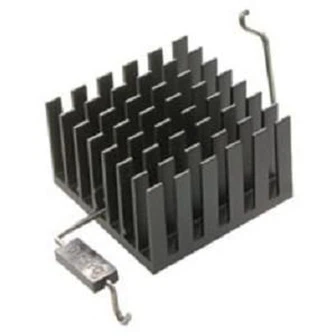
The heatsink is an aluminum or copper structure, which can obtain heat from the heat source through conduction and transfer the heat to the air flow to realize convection.
Heatsinks come in thousands of sizes and shapes, from small stamped metal fins connecting a single transistor to large extrusions with many fins that can intercept and transfer heat to the convective air flow.

Heatpipes:
Usually means heatpipes assembly modules, It contains the sealed metal pipe of sintering core and working fluid. It is not used as a radiator itself. Its function is to absorb heat from the heat source and transfer it to the colder area.

Working principle of heat pipe:
The heat source converts the working fluid into steam in the sealed pipe, and the steam transfers heat to the colder end of the heat pipe. At this end, the vapor condenses into a liquid and releases heat, while the fluid returns to the hotter end.

Fan:
It is the first step to abandon the passive heatsink and heat pipe and move towards the active heat dissipation device of forced air cooling, but the fan also has some disadvantages:
1. increase the cost , need more space .
2. consumes energy and affects the efficiency of the whole system,and may lead failure.
3. creat nose issue
However, in many cases, especially when the air flow path is curved, vertical or blocked, they are usually the only way to obtain sufficient air flow.

Power thermal management can reduce the temperature of components and internal environment in the power supply, prolong the service life of products and improve reliability. It involves the balance of size, power, efficiency, weight, reliability and cost. The priorities and constraints of the project must be evaluated.
Thermal solutions for every industry is very important as the power is gradually higher and higher, Sinda Thermal can provide varieties heatsinks and coolers which inlcuding aluminum extruded heatsink, high performance heatsink, copper heatsink, skived fin heatsink, liquid cooling plate and heat pipe heatsink. please contact us if you have any questions about thermal solution.
website: www.sindathermal.com
contact:castio_ou@sindathermal.com
Wechat: +8618813908426