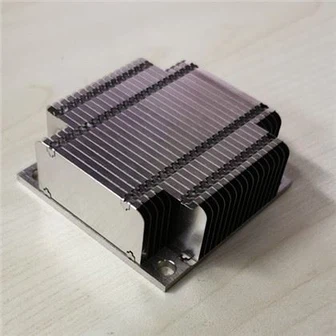
What determines the performance of CPU heatsink
There are many factors affecting the heat dissipation performance of CPU air cooling heatsink, such as material thermal conductivity, fin area, fin spacing, bottom thickness, contact area, fluid flow direction, etc. the classification of heatsink includes heat pipe cooler and CPU cooleer without heat pipe, tower type and down pressure type. Due to the weak performance of CPU heatsink without heat pipe, it is less and less used in the market. At present, most of the more widely used CPU heatsinks are heat pipes CPU cooler.

Down pressure heatsink:
There are generally two advantages of the down pressure heatsink structure. The first is that it is relatively low in height and can adapt to various chassis, especially the mini itx chassis with limited space. Most of them can only use the down pressure air-cooled radiator; Second, it can use the air flow to dissipate heat to the components around the CPU, such as power supply circuit and memory, which can avoid the problem of heat accumulation of these components.

However, this structure is not conducive to the air duct inside the chassis, which is easy to cause turbulent flow inside the chassis. It is difficult to maximize the heat dissipation efficiency, resulting in further loss of heat exchange efficiency. Therefore, it is difficult for the down pressure radiator to achieve high heat dissipation efficiency, which is why it slowly withdrew from the mainstream.
Tower heatsink:
The heat exchange efficiency of the tower heatsink is higher than that of the down pressure heatsink. When the air flow passes through the cooling fins in parallel, the air flow speed on the four sides of the air flow section is the fastest. At the same time, the tower heatsink is also conducive to the construction of the air duct inside the chassis, which can guide the air flow to be discharged from the cooling port at the rear of the chassis as soon as possible.

Advantages of heatPipe heatsink:
The heat pipe is divided into evaporation heating end and condensation end. When the heating end begins to heat, the liquid around the pipe wall will instantly vaporize and produce steam. At this time, the pressure of this part will increase, and the steam flow flows to the condensing end under the traction of pressure. After the steam flow reaches the condensing end, it is cooled and condensed into liquid. At the same time, it also releases a lot of heat. Finally, it returns to the evaporation heating end with the help of capillary force and gravity to complete a cycle.

Because the heat pipe has the advantage of extremely fast heat transfer speed, it can effectively reduce the thermal resistance value and increase the heat dissipation efficiency when installed in the heatsink. It has extremely high thermal conductivity, up to hundreds of times the thermal conductivity of pure copper. Therefore, it is known as "thermal superconductor". The heat pipe CPU radiator with excellent process and design will have strong performance that can not be achieved by ordinary air cooler without heat pipe.

Heatsink Fin Design:
When the base and heat pipe structure are the same, increasing the heat dissipation area is undoubtedly the most direct way to improve the efficiency of the hetasink, and there are no more than two ways to increase the heat dissipation area. The first is to add more or larger heat sinks by increasing the volume, and the other is to reduce the spacing and thickness of heat sinks, Add more heat sinks with the same volume. It is not advisable to blindly pursue a larger heat dissipation area. The volume and weight of the radiator, the thickness and spacing of the heat dissipation fins, and even the size and type of the fan should be carefully considered.

Solder and Fin Penetration process:
There are two main ways to assemble heat pipes and fins: solder and fin penetration. The interface thermal resistance of the welding process is low, but the cost is relatively high. For example, when aluminum fins are welded with copper heat pipes, the heat pipes basically need electroplating treatment before they can be welded with aluminum fins, and the welding process requirements are relatively high, Uneven welding or internal bubbles will significantly damage the heat transfer efficiency.
Fin penetration is to let the heat pipe pass through the fin directly by mechanical means. This process is simple, but the technical requirements are not lower than welding, because it requires that the heat dissipation fin should be in close contact with the heat pipe. The cost of penetrating fin process is slightly lower than that of welding process, and theoretically, the thermal resistance of contact surface is slightly higher than that of welding.

Heat pipe, base and fin are the three main components of the current mainstream CPU air cooling heatsink. Each part will have an important impact on the heat dissipation efficiency of the radiator, and the three parts are also interrelated. Simply enhancing one part may not bring a qualitative leap to the efficiency of the radiator, but any part has not been done well, It is a heavy blow to the efficiency of the CPU heatsink.