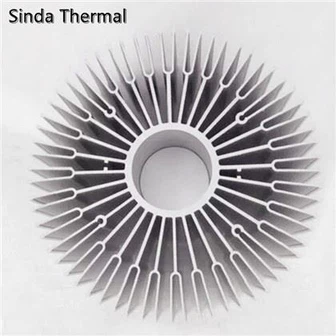
Power Calculation Of Heat Sink
Any device has a certain amount of loss during operation, and most of the loss becomes heat. Low-power devices have low loss and no heat sink is required. High-power devices have large losses. If heat dissipation measures are not taken, the temperature of the die can reach or exceed the allowable junction temperature, and the device will be damaged. Therefore, a heat dissipation device must be added. The most commonly used is to install the power device on the radiator, use the radiator to dissipate the heat to the surrounding space, and add a cooling fan when necessary to enhance the cooling and heat dissipation at a certain wind speed. Flowing cold water cooling plates are also used on the power devices of some large-scale equipment, which have better heat dissipation effects. Heat dissipation calculation is to determine suitable heat dissipation measures and heat sinks through calculations under certain working conditions. The power device is installed on the radiator. Its main heat flow direction is from the die to the bottom of the device, and the heat is dissipated to the surrounding space through the heat sink. If there is no fan to cool at a certain wind speed, this is called natural cooling or natural convection heat dissipation.
The heat transfer process has a certain thermal resistance. The thermal resistance transferred from the device die to the bottom of the device is R JC, the thermal resistance between the bottom of the device and the heat sink is R CS, the thermal resistance of the heat sink to dissipate heat to the surrounding space is R SA, and the total thermal resistance R JA =R JC+R CS+R SA. If the maximum power loss of the device is PD, and it is known that the allowable junction temperature of the device is TJ and the ambient temperature is TA, the allowable total thermal resistance R JA can be obtained by the following formula.
R JA≤(TJ-TA)/PD
Then calculate the maximum allowable thermal resistance R SA from the radiator to the ambient temperature as
R SA≤({T_{J}-T_{A}}\over{P_{D}})-(R JC+R CS)
In consideration of leaving room for design, TJ is generally set to 125°C. The environment temperature should also consider the worse case, generally set TA=40℃ 60℃. The size of R JC is related to the size of the die and the package structure, which can generally be found in the device data. The size of R CS is related to mounting technology and device packaging. If the device is installed with a heat sink after using thermal grease or thermal pad, the typical value of R CS is 0.1 0.2℃/W; if the bottom surface of the device is not insulated and an additional mica sheet is required for insulation, its R CS can reach 1℃/ W. PD is the actual maximum power loss, which can be calculated according to the working conditions of different devices. In this way, R SA can be calculated, and a suitable radiator can be selected according to the calculated R SA value.