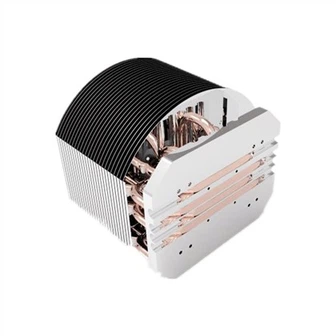
3D printing assists Heatsink manufacture
According to the market observation of 3D science Valley, in recent years, due to the rapid development of electronic components and their application products, the problems of heat loss and thermal safety have become increasingly prominent. As a heat dissipation functional component, the heatsink of electronic products plays a more and more important role in the application field of electronic products. According to the open literature survey, thermal management of electronic products is a market worth US $10 billion and a potential beneficiary of this technology.
3D printing plays an important role in promoting the complexity of heatsink structure. 3D printing used in the manufacture of radiator or heat exchanger meets the development trend of compact, efficient, modular and multi-material products, especially for the processing of special-shaped, structural integration, thin wall, thin fin, microchannel, very complex shape and lattice structure, 3D printing has advantages that traditional manufacturing technology does not have.

Advantages:
1. Manufacturing complex items does not increase costs.
2. Flexible and complex design, not shape limit.
3. No tooling cost require, suitable for Preliminary study.
4. Flexible material choose for different combination.
5. Equipment does not occupy too much space, portable manufacturing.

Challenge:
1. Manufacture cost is still too high for mass production.
2. Capacity issue need to be fixed to meet with rapidly demand increase.
3. Technology is not widely used enough, whick makes the experience share limited.
No matter how mysterious the design is, 3D science Valley believes that electronic products are a highly competitive market, and the final industrialized design must have a road of high stability, high cost performance, economy and continuous iteration. In this regard, the ultimate winner is the perfect combination of design, materials and manufacturing technology.

The constantly increasing power consumption of integrated circuits will generate excessive heat, and in the 5G era, people's demand for computing power continues to increase, and the contradiction between efficient heat dissipation and performance of electronic devices will continue to intensify. The increasing demand for reducing the heat dissipation energy consumption of electronic devices poses a challenge to the efficient optimization design of heat sinks. 3D printing additive manufacturing technology has attracted more and more attention from enterprises and research institutions in the field of radiator manufacturing due to its unique advantages.