3D-VC heat sink, the cooling trend in the era of AI big data
The expansion of IoT, 5G applications and scenarios, as well as the rapid development of AI models, pose severe challenges to the basic computing infrastructure of major operators and manufacturers in terms of high-power heat dissipation. How to cope with high power consumption and efficiently remove heat has become an urgent problem to be solved.

The conventional thermal solution include air-cooled heatsink, heat pipes, and vapor chamber, but traditional heat dissipation methods are obviously not sufficient to meet the constantly developing thermal needs. New cooling solutions are constantly emerging, and 3D-VC (3D vapor chamber ) heat dissipation is one of them. Compared with traditional VC and heat pipes, 3D-VC radiators have little difference in material and working fluid, with copper as the material and pure water as the common working fluid. What truly makes 3D-VC radiators stand out is their efficient heat dissipation efficiency.
Heat pipes belong to one-dimensional linear heat transfer devices. Due to the presence of evaporation and condensation sections, conventional VC soaking plates may have multiple distribution possibilities on the heat dissipation path depending on their design positions. This makes conventional VC soaking plates a two-dimensional heat transfer device, but their heat dissipation path is still limited to the same plane.

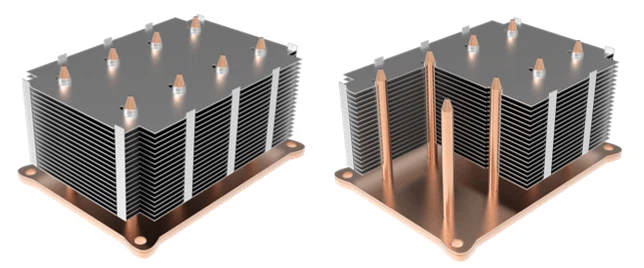
Compared with heat pipes with one-dimensional heat conduction and VC heat plates with two-dimensional heat conduction, the heat conduction path of 3D-VC radiators is three-dimensional, three-dimensional, and non planar. The 3D-VC heat sink utilizes a combination of VC and heat pipes to connect the internal cavity and achieve refrigerant reflux through a capillary structure, completing heat conduction. The connected internal cavity combined with welded fins forms the entire heat dissipation module, enabling multi-dimensional heat dissipation in both horizontal and vertical directions.

The multi-dimensional cooling path allows 3D-VC heat sinks to come into contact with more heat sources and provide more heat dissipation paths when dealing with high power devices. In traditional thermal modules, the heat pipe and VC are designed separately. Due to the increase of thermal resistance value with the increase of thermal conductivity distance, the heat dissipation effect is not ideal. The 3D-VC radiator extends the heat pipe into the main body of the vapor chamber. After the vacuum chamber of the VC homogenization plate is connected to the heat pipe, the internal working fluid is connected, and the 3D-VC radiator directly contacts the heat source. The vertical heat pipe design also improves the speed of heat transfer. The three-dimensional structure of 3D-VC heat sink has the advantages of efficient heat dissipation, uniform temperature distribution, and reduced hotspots, meeting the needs of modern high-power equipment for fast heat dissipation and rapid temperature equalization.

At present, 3D-VC heat sinks are an emerging cooling method, and the demand for 3D-VC heat sinks in the era of integrated high energy consumption is foreseeable. They are mainly used in high-power devices such as servers and base stations that require extremely high cooling efficiency.