

Air volume and pressure of cooling fan
The reason why air can flow must be that there is an energy difference in the system. In our common DC cooling fan, air obtains energy from rotating blades to form air flow. The energy in the air flow is usually expressed in the form of pressure. At any point in the air flow, it exists in the form of static pressure energy, kinetic energy and potential energy, which can be presented by static pressure, dynamic pressure and potential pressure respectively. In daily conditions, due to limited space and small air density, the potential pressure can be ignored.

Why does the wind pressure have to be small when the air volume is large?
The cooling fan converts the electric energy into electromagnetic energy, and then into the mechanical energy of the fan blade, and then transmits it to the air to convert it into static pressure and dynamic pressure. Static pressure is commonly known as wind pressure. For a well designed fan, its maximum air power is subject to motor power and conversion efficiency. Therefore, when the air volume increases, the air pressure must be reduced, and when the air pressure increases, the air volume must be reduced. However, air power is also closely related to the working environment. The size of air volume and air pressure is not a simple negative linear relationship.

The lower the system impedance, the higher the air volume
The concept of air volume is easy to understand. It refers to the volume flow per unit time. The simplest calculation method is q = VA, V is the fluid velocity, and a is the flow area. The unit of air volume in the cooling fan is usually CFM (cubic feet per minute), and the unit of m3 / h can also be used.
System impedance is the resistance of air flow inside the device system. The lower the impedance, the faster the flow rate and the higher the air volume. For example, the impedance of an empty chassis is close to 0. When you install components such as a graphics card, the system impedance will increase. For a radiator, the denser the fins and the larger the area of a single fin, the greater the impedance. Generally, the impedance of the cold row is greater than that of the air-cooled radiator.

Static pressure: ability to overcome system impedance
Theoretically speaking, air molecules are doing irregular thermal movement. The thermal movement of air molecules constantly impacts the wall of the device. The pressure (pressure) presented is called static pressure. Similarly, in a system, the static pressure is not invariable, it increases with the increase of the impedance of the system. The maximum static pressure and maximum air volume cannot occur at the same time. When designing the fan, you can only choose one end for the main air volume or the main air pressure. If you want to increase both, you can only improve the motor power and conversion efficiency. The direct measure is to increase the speed.
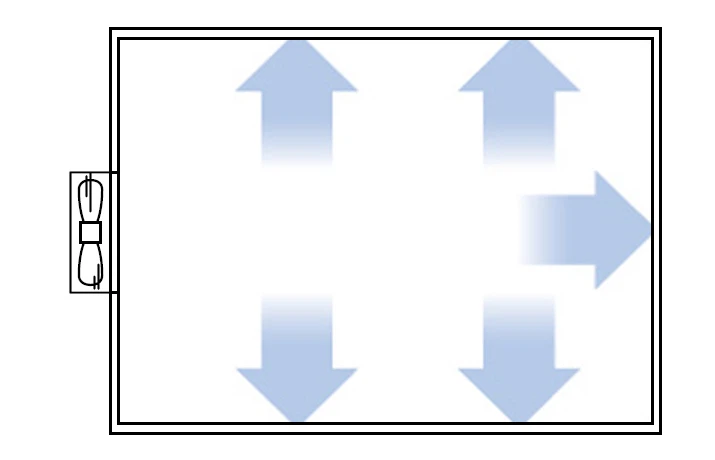
Avoid the stall zone of the fan
There is a dangerous working area of the cooling fan, which is the so-called stall area. In this area, the airflow is turbulent and the fan efficiency is reduced. Generally speaking, try to avoid the working point in the stall area.
When the system impedance is high, it is easy to stall and flow separation. This is mainly because when the system impedance is high, the fan will form a high static pressure. However, if the air intake is insufficient, the air velocity on the suction surface of the fan blade will slowly decrease. Under the action of high static pressure, the boundary layer of the air flow will be damaged, and a vortex zone will appear at the tail end of the blade. The air may directly separate from the blade surface, resulting in turbulence and increased noise, that is, the so-called "stall" phenomenon


