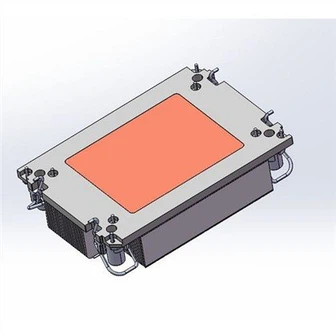
Analysis on Optimal Design of Skive Fin Heatsink
With the increasing power density today, forced air cooling has become the mainstream cooling method for most products. In forced air cooling systems, radiators and fans are almost essential radiators for each of our products, and the two complement each other. However, how to make a better match between the two and maximize the benefits is not an easy task.
The most important thing about the cooperation between the two is that the performance of the fan and the damping of the radiator need to be considered. The damping of the radiator directly determines the operating point of the fan, which directly affects the performance of the fan. The radiator damping is matched with the fan performance, which can not only bring out the maximum benefit of the fan, but also reduce the cost of the radiator.
In addition, the parameter design optimization of the heat sink is also a very critical step. How to design a cost-effective heat sink also needs to be considered from many aspects. The thickness of the heat sink substrate, the height and thickness of the fins, and the tooth spacing can all be optimized. Design, has reached the best heat dissipation effect .
According to the different forming processes of the radiator, it can be roughly divided into profile radiator, shovel radiator, tooth radiator, brazed radiator, etc. The more common ones are profile and shovel radiator. The profile is relatively simple to manufacture, but due to the limitation of its tooth spacing, it is mainly used for heat dissipation of smaller power devices.
The tooth spacing of the spade-tooth radiator can be designed to be smaller, and the fins can be thinner, so it is mostly used for heat dissipation of high-power devices. However, due to the characteristics of its molding process, each radiator needs to be processed from scratch. Say that we can optimize the various parts of the shovel radiator, including the thickness of the substrate, the height and thickness of the fins, and the pitch of the teeth, in the early stage of each project design.
In our actual work, when choosing shovel-tooth radiators, most of them use the shovel-tooth radiators used in previous projects. The shovel-tooth radiators are different from profile radiators. Each of the shovel-tooth radiators needs to be processed from scratch. Choosing the previously used spade radiator does not reduce the cost of the radiator, nor does it achieve the effect of "teaching in accordance with their aptitude".
The power consumption of each project is different from the fan, and the spade radiator that needs to be used is also different. The substrate thickness, fin thickness, tooth spacing and other parameters of the spade radiator will directly affect the cost of the spade radiator. The temperature rise, the performance of the fan. Therefore, when we select the shovel radiator, we should spend as much time as possible to optimize some parameters.
How to optimize the design of shovel radiator?
The optimized design of the toothed radiator is mainly optimized in terms of substrate thickness, fin height and thickness, and tooth spacing. In special cases, the material of the toothed radiator, whether embedded heat pipe or uniform temperature plate, etc. can be designed.
The main optimization design principle is to reduce the thermal resistance of the radiator and match the performance of the fan. These two aspects can be achieved by calculation using formulas or simulation using software. The error of formula calculation is generally 10%-15%. The error of simulation calculation is generally 5%-10%.
The manufacturing process of the shovel-tooth radiator is different from that of the profile radiator, so the shovel-tooth radiator can be designed with more parameters for each item in the use process to match the unused performance of each item. But in our work, we did not achieve this step, more is to directly borrow the radiator from the previous project and use it directly. As everyone knows, it only takes 10-20 minutes to use the formula to calculate the parameters of the shovel-tooth radiator. Simple optimization can obtain a parameter optimization solution of the shovel-tooth radiator, which will greatly improve the cost-effectiveness of the shovel-tooth radiator and also ensure the safety of the components installed on the shovel-tooth radiator.