Classification of liquid-cooled servers
According to the different working media, liquid-cooled servers can be divided into water cooling and refrigerant cooling; according to the cooling method, they can be divided into direct liquid cooling, that is, the refrigerant directly contacts the electronic equipment; and indirect cooling, that is, the refrigerant and the electronic equipment indirectly contact; According to whether a phase change occurs, it can be divided into temperature difference heat exchange, which uses the temperature rise of the refrigerant to take away heat; and boiling heat exchange, which uses the latent heat of vaporization of the refrigerant to take away heat.
Regardless of the mode used or the selected refrigerant, there are many types of liquid cooling technologies.
In terms of system mode, the liquid cooling system is mainly divided into direct cooling (immersion liquid cooling) and indirect cooling (liquid cooling plate, liquid cooling head). These two cooling modes have their own advantages and disadvantages, and have different applications.


Direct cooling type, even if the object to be cooled is in direct contact with the refrigerant, the server motherboard, CPU, memory and other components with high heat generation are completely immersed in the refrigerant (see Figure 1). Since the coolant is in direct contact with the object to be cooled, the heat dissipation effect is better, and the heat dissipation problem of all components can be solved at one time, without the need for additional fans, heat sinks, etc. However, this system has made major changes to the original computer system, and it is necessary to make a sealed cabin to contain the refrigerant; in addition, the system has higher requirements for the refrigerant, and needs to have good insulation performance, non-toxic and harmless, non-corrosive, etc. Physical and chemical properties.
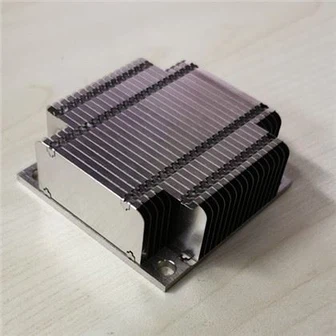
Indirect cooling, that is, the refrigerant is separated from the object to be cooled and does not directly contact it. Instead, the heat of the object to be cooled is transferred to the refrigerant through high-efficiency heat transfer components such as liquid cooling plates (see Figure 2). This system has little change to the computer system, just replace the original air-cooled heat sink with a liquid-cooled heat sink (liquid cooling head), and lead the refrigerant pipeline out of the chassis; in the indirect cooling method, the refrigerant has its own path , It does not directly contact with electronic devices, so as long as the liquid pipeline has good sealing performance and the refrigerant does not leak, the system has low requirements on the refrigerant, and a variety of refrigerants can achieve its functions. The disadvantage is that due to the increased thermal resistance of the heat transfer process, the heat transfer temperature difference increases, and the cooling effect is inferior to that of the direct cooling type. An additional fan must be installed to dissipate the other components of the computer.
Direct and indirect depends on whether the working medium is insulated, while temperature difference cooling and evaporative cooling depend on the boiling point of the working liquid. Among them, the direct boiling heat exchange method using refrigerant is the most efficient and can solve the heat dissipation problem of very high-density servers.
As far as refrigerant is concerned, in the liquid cooling system, there are a variety of products to choose from, such as water, transformer oil, mineral oil, 19.8% ethylene glycol solution, 13.6% NaC brine, FC_75, Coolanol45, dimethane saturated solution, etc. . According to the different working mode and use conditions of the liquid cooling system, a suitable refrigerant should be selected.