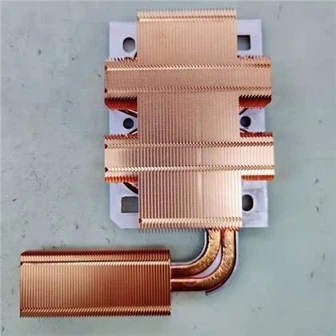
The working principle of liquid cooling server
When air cooling is no longer sufficient to meet the current demand for refrigeration, and even heat dissipation has restricted the development of servers and data centers, liquid-cooled servers have emerged. Liquid cooling is the use of working fluid as an intermediate heat transfer medium to transfer heat from the hot zone to a remote place for cooling. Since the specific heat of liquid is much larger than that of air, and the heat dissipation speed is much greater than that of air, the cooling efficiency is much higher than that of air-cooled heat. Because the fan is omitted, the effect of reducing noise can also be achieved.
The refrigeration principle of the refrigeration system mainly lies in the difference in the way of cold energy transmission. The total heat of the refrigerant is the sum of the sensible heat and the latent heat: during the heating or cooling process, the temperature of the liquid increases or decreases without changing its original phase. No phase change occurs; latent heat, short for latent heat of phase change, refers to the heat absorbed or released by a unit mass of matter from one phase to another under isothermal and pressure conditions. This is the object in the three phases of solid, liquid, and gas. One of the characteristics of the mutual transformation between different solid phases and between different solid phases. The latent heat between solid and liquid is called heat of fusion (or heat of solidification), and the heat of vaporization (or heat of condensation) between liquid and gas , And the heat between solid and gas is called sublimation heat (or sublimation heat).
For the next generation of supercomputers, air cooling technology is difficult to achieve efficient heat dissipation of the system, and water cooling or liquid cooling has two major advantages: one is that it directs the coolant to the heat source instead of indirect cooling like air cooling; the second is the gentle wind Compared with cold, the heat transfer per unit volume, that is, the heat dissipation efficiency is as high as 3500 times. Water-cooled radiators appeared in the market around 2008, and server giants such as HP and IBM, as well as some other companies focusing on data center technology, have successively launched water-cooled heat dissipation products.
Due to the large specific heat capacity of the liquid, it can absorb a large amount of heat and keep the temperature without significant changes. The temperature of the CPU in the liquid cooling system can be well controlled, and sudden operations will not cause an instantaneous and large change in the internal temperature of the CPU. Therefore, the CPU can be allowed to overclock, thereby saving the number of servers. In addition, due to the low noise of the pump, the noise of the entire liquid cooling system is very small compared with that of the air-cooled system, which can achieve the effect of "silent machine room. In addition, because the fan and the special air-conditioning system for the machine room are omitted, it saves electricity and Energy consumption. This technology can be widely used in the heat dissipation of supercomputers and large servers, providing an excellent solution to the heat dissipation problems of large-scale computing centers and data centers.