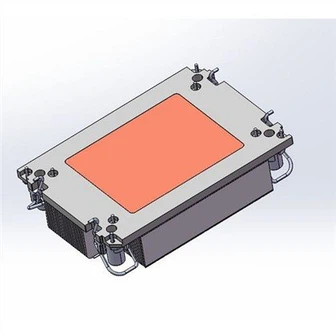
Cold Plate Design Guideline of Industrial energy storage thermal management
In a battery system, a metal radiator suitable for filling indirect contact with liquid cooled working fluid is called liquid cooling. Liquid cooled plates are usually metal plates or tubes extruded or stamped from aluminum alloy grinding tools, which are welded and formed. There are three types of welding for liquid cooled plates: brazing, friction stir welding, and brazing without solder.

The brazing process is widely used in traditional automotive radiator welding. It uses liquid brazing material to wet the base material, fill the interface gap, and diffuse with the base material to connect the welded parts. The welding advantage is that it can weld complex structures, and the thickness of the welded parts can be very thin. Friction stir welding is a welding process that utilizes the heat generated by the mutual movement and friction between the welding head and the workpiece end face to achieve a thermoplastic state at the end. This type of welding requires the workpiece to have sufficient strength. Material free brazing is developed on the basis of brazing, and the thickness and weight of the welded parts can be minimized.

Liquid cooling technology mainly includes three types: cold plate liquid cooling, immersion liquid cooling, and spray liquid cooling. Cold plate liquid cooling is a method in which the heat from high heating components such as server chips is indirectly transferred to the liquid through the cold plate for heat dissipation, while low heating components are still cooled through air cooling. Immersion liquid cooling is when the server is completely immersed in the coolant
The heat generated by the heating element is directly transferred to the coolant, which is dissipated through the circulation flow or evaporation condensation phase change of the coolant. Among them, the circulation flow of the coolant is single-phase immersion liquid cooling, and the evaporation condensation phase change of the coolant is phase change immersion liquid cooling. The control of phase change immersion liquid cooling is more complex and requires higher requirements. Spray type liquid cooling is a method of cooling by directly spraying cooling liquid onto heating units such as chips, and dissipating heat through convective heat transfer. Currently, cold plate liquid cooling and single-phase immersion liquid cooling are the main forms.

In the trend of chip evolution, the power consumption of chip TDP design continues to increase, with a single power consumption reaching 350W and a single even reaching 500W, which will continue to grow in the future. Currently, various liquid cooling technologies can meet the long-term chip heat dissipation needs in the future, and there is further room for improvement. For example, cold plate liquid cooling can reduce contact thermal resistance, microchannel design can strengthen heat transfer, and immersion and spray liquid cooling can improve flow fields.

Regarding the selection of coolant, there are options in the industry such as 25% ethylene glycol solution, propylene glycol solution, deionized water, etc. The concentration of 25% is not a constant value, and can be between 20% and 30%. The concentration should not be too high, which affects the flow and heat dissipation performance of the working fluid. It should also not be too low, and it cannot play a role in antifreeze and microbial inhibition. When the concentration is above 20%, ethylene glycol solution and propylene glycol solution can have a certain inhibitory effect on microorganisms. Deionized water has good heat transfer performance, ultra-low conductivity, mature preparation process, and is non-toxic and safe. It is one of the alternative cooling liquids, but attention should be paid to the maintenance of the cooling liquid.

In the future, thermal design engineers need to accurately grasp the direction of technological evolution and actively conduct discussions and analysis on liquid cooling applications. Highlight innovative and low-carbon development, actively carry out research and pilot trials of liquid cooling technology, and provide efficient and stable thermal solutions for energy storage thermal management.