

Comparison of air and liquid cooling technologies for power electronic devices
With the continuous development of power electronic technology, the volume of converter equipment tends to be compact and the system tends to be complex. High heat density has become an irresistible development trend. In order to meet the demand of high heat density, traditional thermal solutions such as fans and radiators continue to innovate, and novel and efficient heat dissipation methods emerge in endlessly. In front of many cooling methods, it has become a great concern for designers to distinguish the heat dissipation capacity of various heat dissipation methods, so as to choose an economical and reliable heat dissipation method.

Heat transfer capacity:
For air, the heat transfer coefficient of natural air cooling is very low, with a maximum of 10W / (m2k). If the temperature difference between the surface of the heatsink and the air is 50 ℃, the heat taken away by the air per square centimeter of heat dissipation area is up to 0.05W. The heat transfer mode with the strongest heat transfer ability is the heat transfer process with phase change, and the order of heat transfer coefficient of water is 103 ~ 104. The reason why the heat transfer capacity of heat pipe is great is that the heat transfer process of evaporation section and condensation section is phase change heat transfer.

Air Cooling:
The aircooling method has low cost and high reliability. However, due to its small heat dissipation capacity, it is only applicable to the case of small power and large heat dissipation space. At present, the research hotspot of air-cooled heatsink is to integrate the heat pipe and fin, use the high heat transfer capacity of heat pipe to transfer heat evenly to the fin surface, improve the uniformity of fin surface temperature, and then improve its heat dissipation efficiency. Air forced convection cooling is a common cooling method for power electronic components at present. Its common structure is the form of radiator and fan. Although the structure has convenient implementation and low cost, its heat dissipation capacity is limited.

Liquid Cooling:
Although the air cooling technology continues to improve, the air cooling itself is limited by the heat dissipation capacity. With the continuous improvement of heat flux, the application of liquid cooling devices with greater heat dissipation capacity will be popular. According to the research, the approximate range of forced convection heat transfer coefficient of gas is 20 ~ 100W / (M2 ℃), and the heat transfer coefficient of forced convection of water is up to 15000w / (M2 ℃), which is more than 100 times that of forced convection of air.
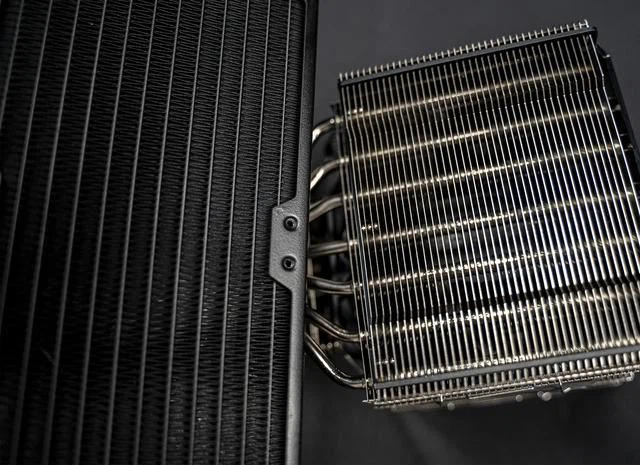
The evaluation of heat dissipation capacity for the heatsink is restricted by many factors, because it is also restricted by environmental conditions, component size, heatsink table temperature and other factors.


