Composite Microchannel Liquid Cooled Plate With Vapor Chamber thermal solutions
With the rapid development of communication technology, the thermal power of electronic devices is also constantly increasing. The power consumption of each evolving generation of products increases by about 30% to 50%. The continuous increase in chip heat flux density directly restricts chip heat dissipation and reliability. At the same time, due to the high power consumption and insufficient capacity of the existing computer room, the computer room faces significant pressure on power supply and heat dissipation. Traditional air cooling is difficult to sustain due to its high heat dissipation noise, high energy consumption, and large footprint.

In this context, liquid cooled data centers with liquid cooled servers and other equipment have emerged, providing new solutions for the cooling and heat dissipation of data centers. In the rapidly developing indirect liquid cooling technology, the liquid cooling plate is the core component of a single-phase or two-phase liquid cooling system. The electronic components are attached to the surface of the liquid cooling plate, and the heat of the electronic components is transferred to the liquid cooling plate through heat conduction. The liquid cooling plate and the working fluid undergo strong and effective convective heat transfer.

The thermal performance of a chip is related to the lifespan of the device. According to research results, the failure rate of electronic components in the communication field is exponentially related to temperature, with the failure rate doubling for every 10 ° C increase in temperature. Compared with traditional forced air cooling, liquid cooling technology has better heat dissipation effect and shorter heat dissipation path. As an emerging and efficient heat dissipation method, it can more effectively solve the pain points of operators regarding the application of high power consumption and high heat flux equipment in computer rooms. In addition, with the increase of equipment power consumption and heat flux density, the advantages of liquid cooling technology such as strong heat dissipation ability, reduced room noise, and green energy conservation will become more prominent.

A new type of vapor chambercomposite microchannel liquid cooling plate. Compared to traditional cold boards, it has more efficient heat dissipation ability and is more suitable for solving high power consumption and high heat flux heat dissipation problems. The liquid cooling plate can be divided into milled groove cooling plate and microchannel cooling plate according to the shape of the flow channel. The milled groove cold plate is formed by machining, and due to processing limitations, its heat dissipation capacity is approximately 65 W/cm2. Microchannel cold plate usually refers to a cold plate with a channel size of 10-1000 µ m, which is mainly processed and formed through a fin scraping process, and has a heat dissipation capacity of approximately 80 W/cm2.

In the field of communication, with the development of digitization, computing power continues to grow, and chip heat flux density continues to rise. It is expected that the chip power density will exceed 100 W/cm2 within 3 years. For high power consumption and high heat flux chips, conventional microchannel cold boards are no longer able to meet the heat dissipation needs. In order to break through the heat dissipation bottleneck, VC and microchannel liquid cooled plates are combined to comprehensively utilize the rapid heat diffusion ability of VC and the heat transfer ability of microchannel liquid cooled plates, solving the heat dissipation problem of high heat flux chips.
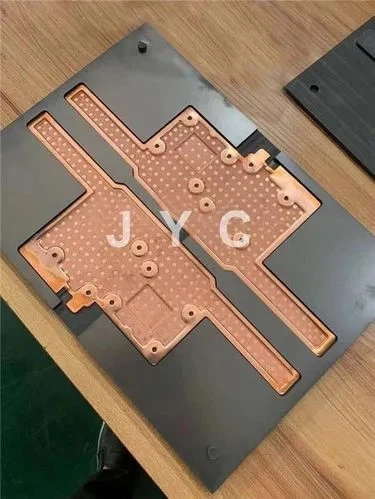
The working principle of a composite microchannel liquid cooling plate with a uniform temperature plate: The chip transfers heat to the interface material and further to the evaporation surface of VC, utilizing the uniform temperature characteristics of VC to achieve rapid diffusion or migration of heat. Then, the convective heat transfer between the working fluid and the cold plate continuously takes away the heat generated by the chip, achieving cooling of the high heat flux chip.