How does crimped fin heatsink made
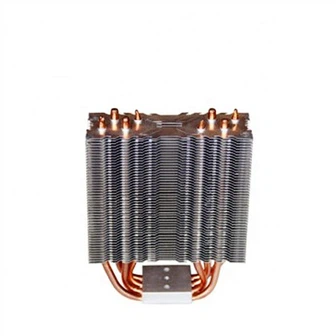
Crimp fin heatsink is first made of aluminum or copper plate into fins, and then combined on the heat dissipation base with grooves with heat transfer paste or solder. The characteristic of crimp fin ehatsink is that the fins break through the original proportion limit, the heat dissipation effect is good, and different materials can be selected as fins. The advantage of this process is that the pin fin ratio of the radiator can be up to more than 60, the heat dissipation effect is good, and the fins can be made of different materials.

The disadvantage is that there will be an interface thermal resistance problem between the fin and the base connected by heat transfer paste or solder, which will affect the heat dissipation. In order to improve these disadvantages, two new technologies are used in the heatsink field.
The first is the plug -in technology, which uses the pressure of more than 60 tons to combine the aluminum sheet in the base of the copper sheet, and there is no medium between the aluminum and copper. From the micro point of view, the atoms of aluminum and copper are connected to each other to some extent, so as to completely avoid the disadvantages of interface thermal resistance caused by the traditional copper aluminum combination, and greatly improve the heat transfer capacity of the product.
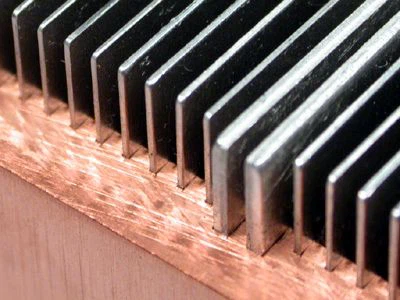
The second is the reflow soldering technology. The biggest problem of the traditional bonded heat sink is the interface impedance, and the reflow soldering technology is an improvement to this problem. In fact, the reflow welding process is almost the same as that of the traditional bonded heat sink, except that a special reflow furnace is used, which can accurately set the welding temperature and time parameters. The solder adopts lead tin alloy to fully contact the welding and welded metal, so as to avoid missing welding and empty welding and ensure the connection between the fin and the base as close as possible, The interface thermal resistance is minimized, and the melting time and temperature of copper for each solder joint can be controlled to ensure the uniformity of all solder joints.