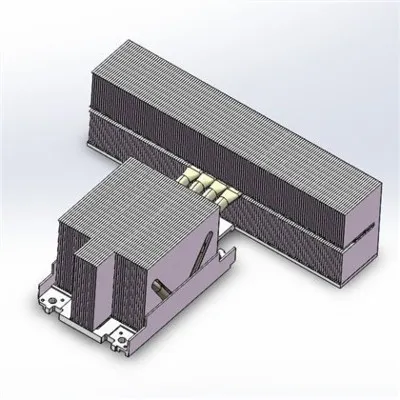
How to keep low temperature: radiator selection and application basis
Most electronic components, especially microprocessors and microcontrollers, continue to increase in thermal density due to the continued shrinking of their size. Given that life expectancy, reliability, and performance are inversely proportional to the operating temperature of the device, the result of this evolution is that thermal design and management have become a major design issue. Therefore, it is the designer's responsibility to have a clear understanding of effective thermal management and available radiator solutions to keep the operating temperature of the equipment within the range set by the supplier.
The working principle of the radiator is to increase the surface area of the device exposed to the coolant (air). If the radiator is installed properly, it can reduce the temperature of the equipment by improving the transfer of heat across the solid-air boundary to the cooler ambient air.
This article outlines the choice of heat sink and provides guidance on proper design, component selection, and best practices to achieve excellent thermal performance. It also describes Ohmite's radiator solution as an example. Most electronic components, especially microprocessors and microcontrollers, continue to increase in thermal density due to the continued shrinking of their size. Given that life expectancy, reliability, and performance are inversely proportional to the operating temperature of the device, the result of this evolution is that thermal design and management have become a major design issue. Therefore, it is the designer's responsibility to have a clear understanding of effective thermal management and available radiator solutions to keep the operating temperature of the equipment within the range set by the supplier.
The working principle of the radiator is to increase the surface area of the device exposed to the coolant (air). If the radiator is installed properly, it can reduce the temperature of the equipment by improving the transfer of heat across the solid-air boundary to the cooler ambient air.
This article outlines the choice of heat sink and provides guidance on proper design, component selection, and best practices to achieve excellent thermal performance. It also describes Ohmite's radiator solution as an example.
The power in an integrated circuit (IC) is dissipated in the form of heat from the active transistor junction, and the temperature of the junction is proportional to the power dissipated. The manufacturer specifies the maximum junction temperature, but it is generally around 150°C. Exceeding this junction temperature will generally cause device damage, so the designer must find ways to transfer as much heat as possible from the IC. To do this, they can rely on a fairly simple model to measure the flow of heat. This model is similar to the electrical calculation of Ohm’s law, based on the concept of thermal resistance, with the symbol θ.
Thermal resistance refers to the resistance encountered when heat flows from one medium to another. Its unit is Celsius/Watt (°C/W), which is defined as follows:
in:
θ is the thermal resistance across the thermal barrier in ℃/W. ∆T is the temperature difference across the thermal barrier in ℃.
P is the power dissipated by the node, in watts. From the physical layout of the IC and the heat sink, there are many thermal interfaces. The first is between the junction and the case of the IC and is represented by the thermal resistance θjc.
The heat sink is bonded to the IC using thermal interface material (TIM) such as thermal paste or thermal tape to enhance the thermal conductivity between the two devices. This thermal conductive layer generally has a very low thermal resistance, which is part of the thermal resistance from the shell to the heat sink and is represented by θcs. The last level is the interface between the radiator and the surrounding environment, denoted by θsa.
Thermal resistance is like resistors in electronic circuits, which are connected in series. The sum of all thermal resistances is the total thermal resistance from the junction to the ambient air.
Generally, IC vendors will implicitly or explicitly specify the thermal resistance from junction to case. This specification may be provided in the form of maximum case temperature, eliminating one of the thermal resistance elements. The designer of the application IC has no control over the thermal resistance characteristics of the junction to the case. However, the designer can select the TIM and heat sink features to fully cool the IC and keep the junction temperature below the specified maximum temperature. Generally speaking, the smaller the thermal resistance of the TIM and the heat sink, the lower the case temperature of the IC to be cooled.
From the perspective of heat dissipation, choosing a radiator is relatively simple. As mentioned above, the Ohmite BG series heat sink provides a feasible solution to the cooling problem of ICs in BGA packages.