

Intel Whitley/Cedar Island Anti-Tilt Heat Staking Guidance
1. Introduction:
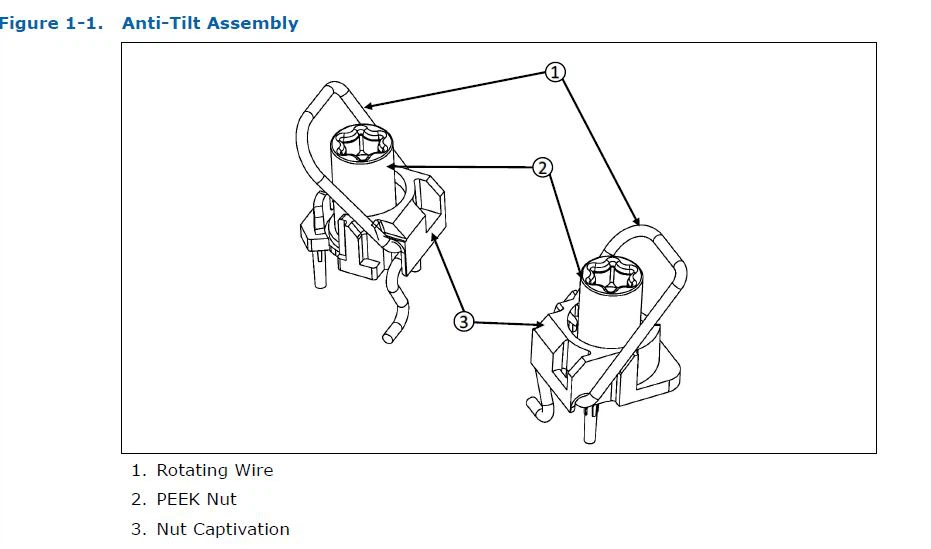
Whitley and Cedar Island heatsink reference retention solution contains a set of 4 Anti-Tilt Systems. These, are comprised of a PEEK Nut, a Rotating Wire and a Nut Captivation. The following guide is intended to facilitate customers in the installation process of Anti-Tilt assembly through the heat stake process. The installation spec and test procedure documented in here apply only to the thermal solutions working with LGA4189-4/5 sockets.
2. Set-Up And Procedure:
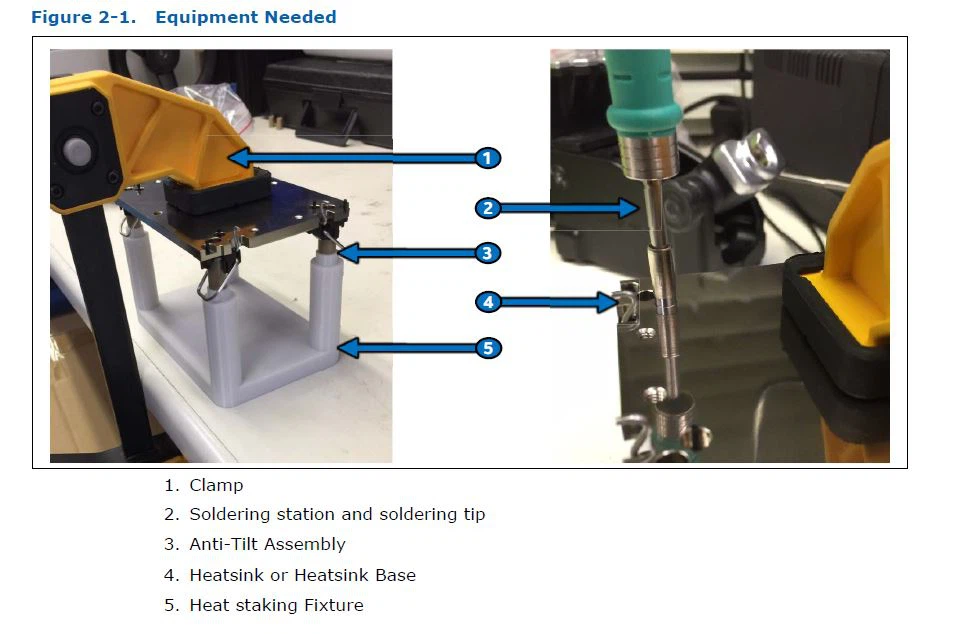
The following procedure is intended to help customers and suppliers in the process of
heat staking the reference anti-tilt solution from our enabled suppliers, final user should check that the assembly complies with Intel’s specs and drawings.
Heat staking Procedure:
1. Clamp the fixture and heatsink/heatsink base firmly together.This will push the nut captivation stakes through the Heatsink/Heatsink Base.
2. Preheat the solder tip to about 200℃.
3. Press the solder tip down firmly on the exposed heat stake, melting it until the soldier tip bottoms out in the counterbore.
4. Reduce temperature of solder tip to about 115 oC (Solder tip is still pressing down into the counterbore).
5. Once the tip has reached 115 oC, rotate and pull out the solder tip. The tip should leave a smooth/continuous dome shape.
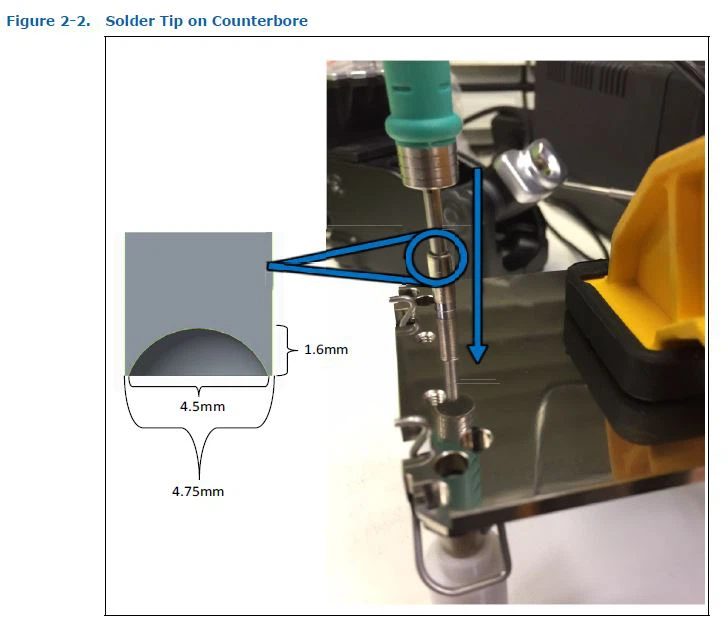
Notes: The heatstaking process takes about 12 seconds with Intel's setup, which uses a pedadl to quickly reduce temperature from 200℃to 115℃.
3. Assembly Tests:
The following test procedures intend to give a quick validation of the heat staking assembly seen in Chapter 2, “Set-Up And Procedure”, end user is responsible to do the additional testing and procedures to ensure the quality of the assembly complies with the final product.
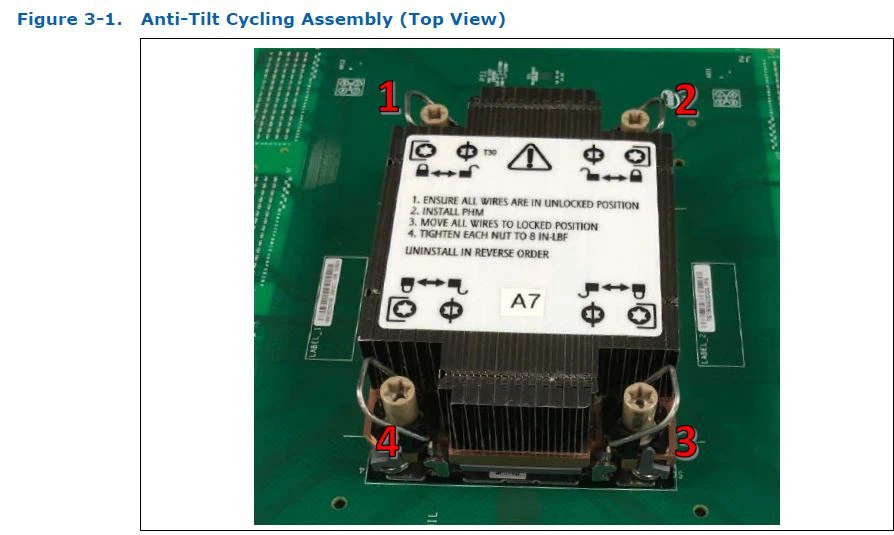
3.1 Heat stake Strength Test #1: Anti-Tilt Cycling
1. Prepare a TFLM Assembly into a board (Board, Loading Mechanism, Carrier, Package, etc.)
2. Move the anti-tilt wires on the heatsink to the "latched"position
Make sure the wire slides under the hooks on the bolster
3. Fully load one PEEK Nut to 8-in-lb and see if the opposite anti-tilt corner
wire stays under the bolster hook
4. Unload the PEEK Nut
5. Repeat steps 3-4 thirty (x30) times
6. Repeat steps 3-5 on each of the other three PEEK Nuts
3.2 Heat Stake Strength Test #2: Push/Pull on PEEK Nut
1.Ensure the anti-tilt wires are in the "latched"position.
2.Constrain/hold the opposite end of the heatsink base (so it does not lift up).
3.Insert 8-32 screw/bolt 4-6 threads into the peek nut
4.If the heatsink is upside down, use a force gauge to push downward on the bolt, which is threaded into the PEEK nut, until the heat stake break.
Notes:The heat stake should break before the PEEK nut is pushed out of the nut captivation, If the heat stake is facing up, use a force gauge to grab and pull up on the bolt, which is threaded into the PEEK Nut, until the heat stake breaks.
The goal is to have a break force of at least 25 lbf on each corner.

All the Intel Whitley/Cedar Island Anti-Tilt heat sink modules made by Sinda Thermal company can 100% meet with intel's spec on releated reliability test. We had successfully provided both 1U and 2U CPU sink under intel whitley/Cedar platform for customers' mass production, and we're also good at other customized platform thermal products for many application fields. Feel free to contact with us if you have thermal solutions issues.
website: www.sindathermal.com
contact:castio_ou@sindathermal.com
Wechat: +8618813908426


