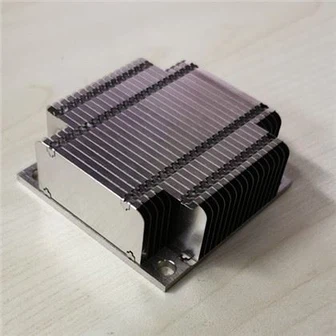
Introduction to the heat dissipation of photovoltaic inverters
Photovoltaic inverter:
The direct output of solar energy is mostly 12VDC, 24VDC, 48VDC. The effective conversion of the DC power generated by the system to AC power should be realized, so as to give enough power to 220VAC appliances, so the main choice is the DC-AC inverter. The main function of the inverter is to realize the effective conversion of direct current to alternating current. Both solar cells and storage batteries are DC power sources, so once the load contains AC power, the inverter becomes an indispensable part.

Heat dissipation problems of photovoltaic inverters
According to statistics, every time the temperature of electronic components rises by 2 ℃, the reliability decreases by 10%, the temperature rise is 50 ℃, and the service life is only 1/6 of that at 25 ℃. Therefore, the electronic components must be effectively dissipated in order to ensure the reliable operation of the devices. It can be seen that the heat dissipation problem has increasingly become an important factor affecting the development of electronic technology, especially for the power electronics industry.
The main heat dissipation components of the inverter are the IGBT and the inductor, especially the core component of the inverter-IGBT (Insulated Gate Bipolar Transistor), which generates a lot of heat during operation, which is about 1~1.5% of the rated power. It is dissipated in the IGBT and converted into heat. This part of the heat will heat the die of the power device and increase the junction temperature. If this heat cannot be released in a timely and effective manner, it will affect the performance of the device, thereby reducing the reliability of the system's work, and even damage the device. The allowable operating temperature of IGBT is generally lower than 125~150°C, so effective means must be used to dissipate heat to the environment. At present, the commonly used method for inverters with lower power is to install the IGBT on a radiator and rely on natural heat dissipation methods for cooling.
Heat dissipation design
In actual heat dissipation design, natural cooling, forced air cooling or liquid cooling are generally selected according to the ratio of heat per unit time to heat dissipation area, that is, heat flux (heat flow density).
Heat sources are generally divided into centralized heat sources and uniform heat sources. When the heat dissipation area of centralized heat sources such as IGBTs is limited, the heat is carried by the heat pipe to the uniform temperature plate and then conducted to the radiator. For uniform heat sources, such as lithium batteries, heat pipes are generally not used .
Other input information needs to have information such as the structure diagram of the part, the thermal conductivity of the part, the heating power, the ambient temperature and pressure, and the heat loss.
Outdoor low-power photovoltaic inverters have a harsh and complex working environment. They not only require stable and reliable ventilation and heat dissipation performance, but also require a good protection level. Generally, the protection level is required to be above IP54. Conflicting requirements give thermal design constraints. It's very difficult.
For such problems, the traditional approach is to use fans with high levels of protection (waterproof, dustproof, etc.) to enhance heat dissipation. Although this method has a good heat dissipation effect, the maintenance of the fan is still an inevitable task in a harsh working environment. To a certain extent, it not only increases the cost, but also reduces the life index of the product. As a passive cooling method, natural convection cooling has many advantages such as high reliability, maintenance-free, good stability, no noise, no power consumption, no moving parts, etc. It provides a new technical way to solve such problems.