

LED thermal heatsink design
With the continuous evolution of LED materials and packaging technology, the brightness of LED products is continuously improved, and LED applications are more and more widely. The power of the original single-chip LED is not high, the calorific value is limited, and the heat problem is not big, so its packaging method is relatively simple. However, in recent years, with the continuous breakthrough of LED material technology, the packaging technology of LED has also changed. The input power of a single LED is up to more than 1W, and even up to 3W to 5W pr higher with technology developed.

Because the thermal problems derived from high brightness and high power LED system will be the key to affect the product function, in order to quickly discharge the heat of LED components to the surrounding environment, we must first start with the thermal management at the packaging level. At present, the industry's solution is to connect the LED chip to a soaking plate with solder or thermal conductive material to reduce the thermal impedance of the packaging module through the heat sink, which is also the most common LED packaging module on the market.

The heat dissipation components of LED are similar to that of CPU. They are mainly air-cooled modules composed of heat sink, heat pipe, fan and thermal interface materials. Of course, liquid cooling is also one of the thermal countermeasures. In terms of the most popular large-size LED TV backlight module at present, the input power of 40 inch and 46 inch LED backlight is 470w and 550W respectively. In terms of 80% of them turning into heat, the required heat dissipation is about 360W and 440W.

Air Cooling :
Air cooling is the most common way of heat dissipation, and it is also a cheaper way. In essence, air cooling is to use a fan to take away the heat absorbed by the heatsink. The utility model has the advantages of relatively low price and convenient installation. However, it is highly dependent on the environment. For example, when the temperature rises and overclocking, its heat dissipation performance will be greatly affected.

Liquid cooling:
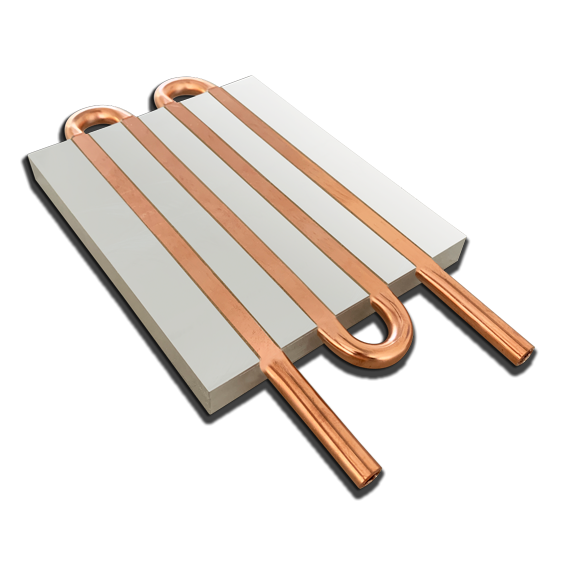
Liquid cooling takes away the heat of the LED through the forced circulation of liquid driven by the pump. Compared with air cooling, it has the advantages of quiet, stable cooling, less dependence on the environment and so on. The price of liquid cooling is relatively high, and the installation is relatively troublesome. For the consideration of cost and ease of use, water is usually used as the heat conducting liquid for liquid cooling heat dissipation, so liquid cooling heatsinkis often called water-cooled heatsink.
Semiconductor refrigeration cooling:
Semiconductor cooling uses a special semiconductor refrigeration chip to generate temperature difference when powered on. As long as the heat at the high temperature end can be effectively dissipated, the low temperature end will be continuously cooled. There is a temperature difference on each semiconductor particle. A refrigeration sheet is composed of dozens of such particles in series, so a temperature difference is formed on the two surfaces of the refrigeration sheet. Using this temperature difference phenomenon, combined with air cooling / water cooling to cool the high-temperature end, excellent heat dissipation effect can be obtained.
Semiconductor refrigeration has the advantages of low refrigeration temperature and high reliability. The cold surface temperature can reach below minus 10 ℃, but the cost is too high, and it may cause short circuit due to too low temperature. Moreover, the process of semiconductor refrigeration chip is not mature and not widely used.


