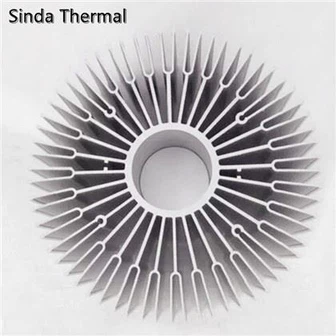
Precautions for copper-aluminum composite radiator
1. In the calculation, the maximum power consumption value in the device data can not be taken, but it should be calculated according to the actual conditions; the maximum junction temperature in the data is generally 150 ℃, and there is room for 125 ℃ in the design, and the ambient temperature is also Can not take 25 ℃ (to consider the actual temperature of summer and the case).
2. The installation of the radiator should consider the direction conducive to heat dissipation, and open a heat dissipation hole in the corresponding position on the chassis or casing (to make the cold air enter from the bottom, and the hot air escape from the top).
3. If the shell of the device is an electrode, the mounting surface is not insulated (not insulated from the internal circuit). Mica gaskets must be used for insulation during installation to prevent short circuits.
4. The pins of the device must pass through the heat sink, and drill holes must be drilled on the heat sink. In order to prevent the pin from colliding with the hole wall, a PTFE sleeve should be put on it.
5. In addition, different types of radiators have different thermal resistances under different heat dissipation conditions, which can be modified during design, that is, in actual applications, they can be calculated by referring to the thermal resistance of these radiators, and similar structural shapes can be used ( The radiator composed of cross-sectional area and perimeter) can be used instead.