

Rotating Heatsink Technology
Sandia National Laboratory in the United States is a national laboratory dedicated to various cutting-edge scientific research. Since its establishment, their research results are countless, creative and forward-looking.
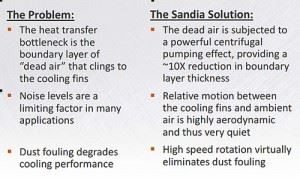
Sandia cooler is an improved design for the traditional air-cooling heatsink. They find another way to start from destroying the thermal boundary layer, which seems to make the heatsink itself rotate and replace the traditional fan. It's also called rotating heatsink.

It has many advantages compared with traditional air cooling heatsink, such as:
1. High efficiency, the same thermal resistance, its volume is much smaller (one tenth).
2. Dust proof effect is remarkable.
3. Low noise, smaller than traditional fan.
4. High relaibility.
Of course, it also has disadvantages. From the data, the power consumption is slightly higher under the same thermal resistance.
Working Principle:
The high-speed air flow destroys the boundary layer and improves the heat transfer efficiency.
Structure:

1. The base bottom contact with the heat source adopts the structure of vapor chamber.
2. Specially designed heat sink fin is adopted.
3. There is a gap of 0.02mm between the heat sink and the substrate . How to ensure that this gap can remain unchanged during operation? In short, the adaptive structure ensures the stability of the gap.
Performance:

Compared with the traditional CPU cooler, the volume is less than one tenth of the same performance.


