Server Cooling technology
Under the background of the surging development of cloud computing industry, more and more data centers have been established. As the core equipment of the data center, the server's high performance, high availability and high cost performance have become important indicators to measure the quality of the server. Due to the limited volume of the server, many high-power electronic components operate for a long time and under high load. Whether the heat generated by the electronic components can be transferred to the outside in time is directly related to the stability of the server. Therefore, the heat dissipation of the server has become a major obstacle to the development of the server.

Server cooling technology mainly includes: air cooling , liquid cooling , heat transfer and intelligent control. Among them, air cooling and liquid cooling are still the two core technologies in the field of server cooling technology. In addition, the biggest technical feature in the field of server cooling is that it rarely uses a single cooling technology.
The principle of air cooling and heat dissipation is simply to guide the direction of the wind, blow the cold air into the heating element, or extract the hot air from the heating element. Common technologies include fan and air guide cover. The former can adopt exhaust fan or blower fan, and the latter can guide the direction of wind according to specific air duct to form specific air flow direction in the process of heat dissipation.

The principle of liquid cooling is simply to take away the heat of the heating element through the immersion or flow of liquid by means of heat convection or heat conduction. Common liquid cooling methods include immersion and liquid cooling circuit. Because electronic components are easily damaged by water, the liquid used for immersion is oil, fluoride and other liquids that are not easy to conduct electricity, while the liquid cooling circuit contacts the electronic components with a closed liquid circuit to take away the heat generated by the electronic components through liquid flow. Cold water is often used as the liquid.

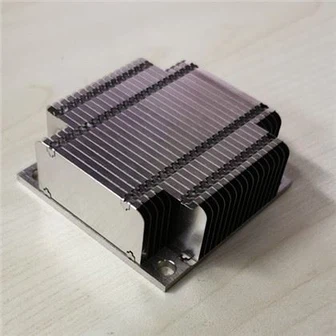
The principle of heat transfer is the cooling method of heat conduction, the heat is transferred from high-temperature objects to low-temperature objects. Common cooling technologies include: heat sink, cooling plate and semiconductor plate. The heat dissipation technology using semiconductor plates is based on the Peltier principle, that is, when the circuit composed of two different conductors A and B is connected with direct current, one connector releases heat and the other connector absorbs heat. When the current direction is changed, the heat absorption and heat release parts are exchanged, so as to achieve the heat dissipation effect.

Intelligent control. The principle of intelligent control is to use sensors to monitor the temperature and load inside the server, and adjust the fan speed or liquid flow rate through the corresponding control circuit. It belongs to an intelligent heat dissipation.