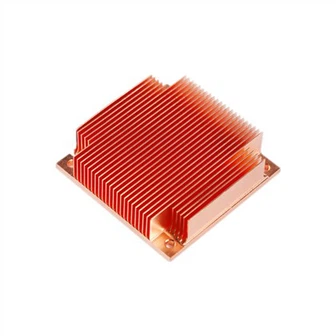
The comparison of Active and Passive Heat Sinks for Inverters
When looking for an appropriate heat sink for inverter application, you may be wondering whether to choose an active or passive heat sink. Both options offer unique advantages, but which one is better for your inverter?
Active heat sink
As the name suggests, active coolers require external power to operate. This type of radiator cools the inverter by using a fan or pump to circulate air or liquid over the radiator.
One of the main advantages of an active heat sink is that it can regulate the temperature of the inverter more precisely than a passive heat sink. This type of heatsink is especially suitable for high power applications as it dissipates heat more efficiently.
However, like any device that requires an external power source, active heatsinks are prone to failure if the power supply is interrupted. It also produces unnecessary noise, which may not be acceptable for some applications.

Passive heat sink
In contrast, passive radiators do not require any external power source to operate. Instead, it relies on natural convection of air or liquid to remove heat from the inverter.
One of the main advantages of a passive radiator is its simplicity. This type of radiator is easy to install, maintain and operate. It also produces no noise, making it ideal for noise-sensitive applications.
However, passive heat sinks may not be sufficient for high power applications. Because it relies on natural convection, it may not dissipate heat as effectively as an active radiator. This can lead to overheating and reduced performance.

Which one to choose?
As you can see, both active and passive radiators have advantages and disadvantages. Which one you choose depends on your specific application and needs.
If you need precise temperature control and have high power requirements, an active heat sink may be a better choice for you. However, if you need a simple, reliable and noise-free solution, passive heat sinks are probably the best option.
In any case, it is crucial to choose a heat sink that is compatible with the inverter and meets its cooling requirements. Remember that the size, shape and material of a heat sink also play a critical role in its performance.
When it comes to cooling inverters, there are two main options: active and passive heat sinks. While both have unique advantages and disadvantages, the ultimate choice depends on your specific needs.
If you're still not sure which type of radiator is right for you, consider consulting a professional or doing further research. With the right heat sink, you can ensure your inverter is running at peak performance and avoid costly failures.
Sinda Thermal is a leading thermal manufacturer in China, our factory was founded in 2014, and located in Dongguan city, China, we are offering varieties of heatsinks and other precious metal parts. Our plant possesses 30 sets advanced and high precious CNC machines and stamping machines, also we have many testing and experiment instruments and professional engineering team, so our company can manufacture and provide high quality products with high precision and excellent thermal performance. Sinda Thermal is commited to a range of heat sinks which are widely used in new power supply, New energy vehicles, Telecommunications, Servers, IGBT, and Madical. All the products accord with Rohs/Reach standard, and the factory is qualified by ISO9001 and ISO14001. Our company has been a partner with many customers for good quality, excellent service and competitive price. Sinda Thermal is a great heat sink manufacturer for the global customers .