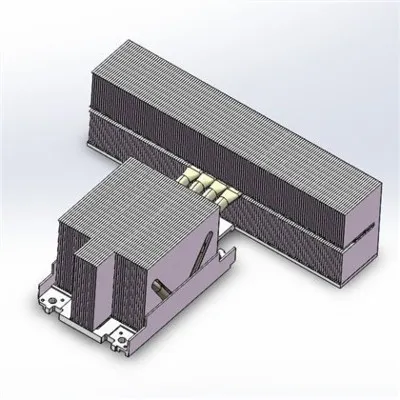
The working principle of the CPU air-cooled radiator
The CPU heat sink is an accessory used to assist CPU heat dissipation, creating a good heat dissipation environment for the CPU. If the CPU heat sink is not selected well, the CPU will automatically reduce the frequency to reduce heat in order to protect itself from being burned out. It will lead to a decrease in CPU performance, so it is very important to choose a CPU cooler.
How to choose a suitable air-cooled radiator? This article will give you some basic knowledge about air-cooled radiators.
working principle:

The CPU radiator base is in direct contact with the CPU, and the CPU conducts heat to the radiator base through silicone grease, and then the base is transferred to the radiating fins through the heat-conducting device, and the heat on the radiating fins is blown away by the fan.
Heat conduction device:

①Pure copper (pure aluminum) heat conduction: This method has relatively low heat conduction efficiency, but has a simple structure and low price. Many original radiators use this method.
②Heat conduction copper pipe: This is the most commonly used method now. Its copper pipe is hollow and filled with a kind of heat conduction fluid. When the temperature rises, the liquid at the bottom of the copper pipe evaporates and absorbs heat, and the heat is transferred to the heat dissipation fins. Reduce the condensation into a liquid, flow back to the bottom of the copper pipe, and circulate in this way, and the heat conduction efficiency is very high. So most of the current radiators are in this way.
③Water: It is what we often call water cooling. Strictly speaking, it is not water, but a liquid with high thermal conductivity. It uses water to take away the heat of the CPU, and then the high-temperature water is blown away by the fan when it passes through the tortuous cold row (the structure is similar to the radiator in the house), and becomes cold water and circulates again.