Two phase immersion liquid cooling overcomes the challenge of coolant leakage
In order to meet the real-time computing needs of massive data and the growing demand for AI applications, the computer industry has shifted towards chip architectures that can handle higher power. At present, the power of a single chip CPU has increased from 150 W to over 300 W; The power of a single GPU has increased to over 700W. Traditional air cooling faces the challenge of reaching the cooling limit in high-power density servers, therefore, the application and research of liquid cooling in data centers have become an urgent need.

On the one hand, two-phase immersion liquid cooling can achieve higher density processing capacity in limited spaces, which is considered to lead the development trend of liquid cooling; On the other hand, due to the significant issues of material compatibility, heat balance, steam recovery, and economic benefits, many people believe that two-phase immersion liquid cooling is still a challenging scientific project.

The two-phase immersed cooling systems currently being explored are often harmful to organisms and the environment. Although manufacturers have implemented rigorous measures to prevent a large amount of coolant loss into the environment, breakthroughs need to be made in coolant leakage, lower usage costs, and better maintainability for two-phase immersed cooling data center racks.
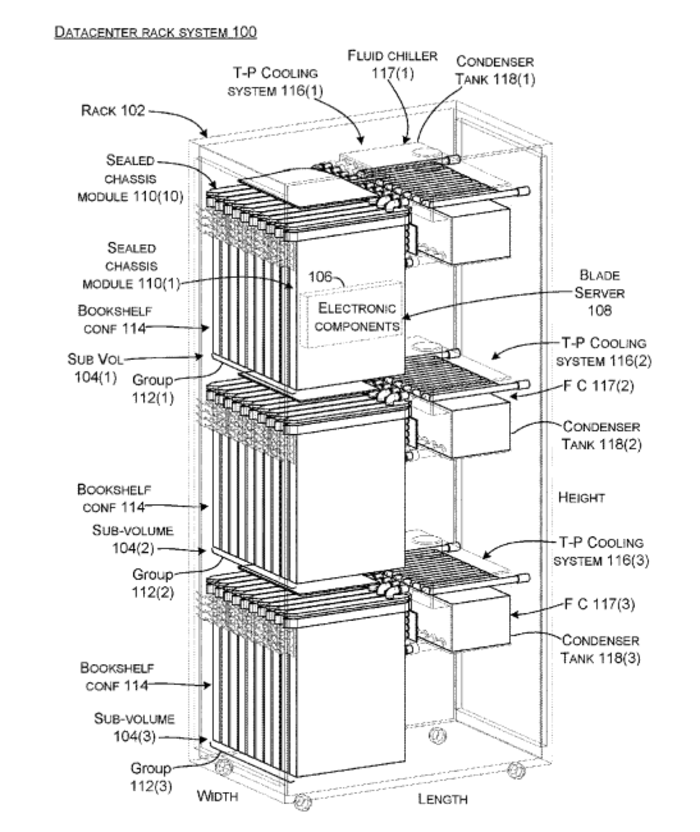
Microsoft has prepared an innovative conceptual design for the two-phase immersed liquid cooled data center rack system, seeking to address the above issues. A separate sealed chassis module can contain one or more electronic components immersed in a two-phase coolant. When the electronic components operate and heat up, the coolant around the electronic components undergoes a phase transition from the liquid phase to the gas phase, and reaches the two-phase condenser tank through a steam coupling. It is then cooled in the two-phase condenser tank and undergoes a phase transition back to the liquid state. A separate sealed chassis module can be separated from the two-phase condenser box without releasing two-phase coolant, and the rack can include multiple sealed chassis modules and the condenser box as a whole.
In recent years, two-phase immersion liquid cooling has been favored by Microsoft due to its excellent cooling efficiency and energy consumption performance. In April 2021, Microsoft announced that two-phase immersion liquid cooling can reduce the power consumption of any given server by 5% to 15% when used as a cooling solution for high-performance applications such as artificial intelligence.
Driven by this result, the Microsoft team collaborated with data center IT system manufacturer and designer Wiwynn to apply their first two-phase immersion cooling solution to Microsoft's Azure data center in Quincy, Washington.