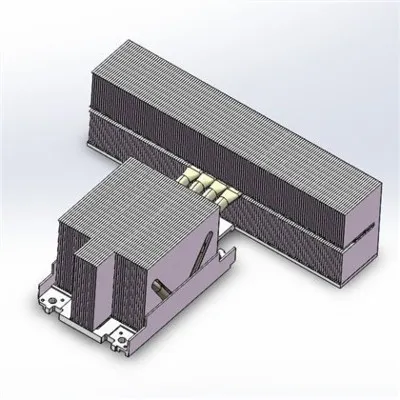
UV LED Cooling
UV-LED is a new solid-state UV light source after traditional gas UV light sources such as mercury lamp and xenon lamp. It has the advantages of stable performance, single adjustable light wave, high luminous efficiency, low energy consumption, green environmental protection and so on. It has become the best replacement product in most UV application fields at present. In recent years, with the rapid development of UV-LED and the continuous improvement of its system power, heat dissipation has become an important factor hindering its development. The increase of chip junction temperature leads to the decline of UV-LED performance. In order to maintain the good characteristics of UV-LED system under high-power conditions, we must strengthen the heat dissipation of the chip.

UV-LED air cooling heatsink:
UV-LED Air cooling heatsink can be divided into extrusion type and heat pipe type according to the category. Due to the high power density of array UV-LED chips, natural convection can provide small heat dissipation capacity and high heat consumption, so forced convection is usually used instead of natural convection.
The extrusion air cooling heatsink usually used on the low power UV-LED cooling ,and it has high reliability and lower cost due to the simple structure.

Heat pipe is a high-efficiency heat conduction device, which mainly uses phase change heat transfer. The heat pipe itself has no cooling effect, but is a good heat conductor. Fins are usually distributed outside the U-shaped heat pipe, which meets the requirements of miniaturization and convenience of UV curing system and ensures the uniformity of heat dissipation surface temperature.

UV-LED liquid cooling heatsink:
The liquid cooling heatsink drives the liquid flow through the water pump to take away the heat. The liquid cooling radiator usually uses water as the coolant. Because the thermal conductivity of water at the same temperature is about 20 times that of air, its heat transfer capacity is greater than that of air, and the specific heat capacity of water is much larger than that of air, so it can effectively absorb the heat generated by UV-LED chips. The liquid cooling radiator of compact UV-LED device can be integrated into the application with limited space around the curing area, and is widely used in many occasions.

New Cooling Heatsink:
In addition to the traditional air cooling heatsink and liquid cooling heatisnk, in order to effectively heat the UV-LED system, some new radiators have emerged, such as thermoelectric refrigeration, liquid metal cooling and so on.
In the process of thermoelectric refrigeration and heat dissipation, semiconductor refrigeration sheet (TEC) can only be used as heat dissipation carrier. Tec has a compact structure, and the heat flux that can dissipate heat is usually low, and it is usually used for the heat dissipation of low-power UV systems, and then the heat is discharged through other cooling methods.

The problem of heat dissipation has become a technical bottleneck that limits the power improvement of UV-LED system. The problem of heat dissipation of high-power UV-LED must be solved by combining heat transfer, material science and manufacturing technology. Heat transfer provides heat dissipation means, material science improves the thermal conductivity of materials, and manufacturing technology improves the manufacturing process.

Air cooling and liquid cooling heatsinks are the most widely used technologies at present. In addition, new cooling methods such as thermoelectric refrigeration and liquid metal have also emerged. However, in the field of improved thermal technology, there are still many places worth exploring, and the research of new cooling methods needs further development. In the structural design of cooling heatsink , the research direction in recent years is to improve the existing structure through optimization methods, material selection and technology.