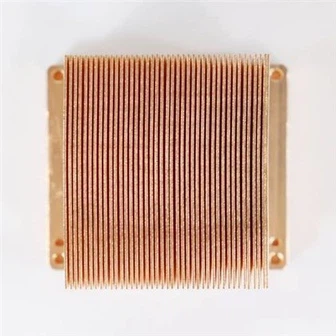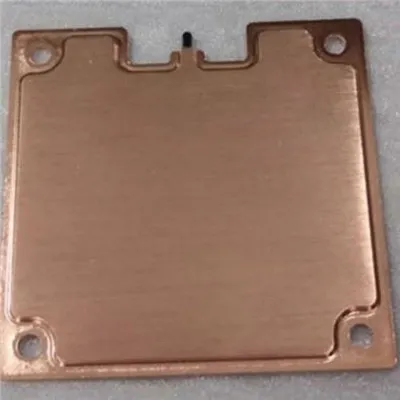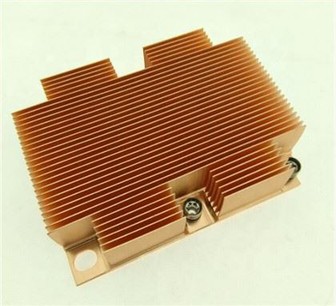
Vacuum diffusion welding liquid plate
Vacuum diffusion welding technology is a special welding process developed rapidly to meet the needs of cutting-edge science and technology fields such as atomic energy, aviation, aerospace and electronic industry. It is to heat two flat and smooth welding surfaces to a certain temperature under certain vacuum conditions. Without adding any solder or intermediate metal, under the simultaneous action of temperature and pressure, after micro plastic rheology, they are in close contact with each other, and the electrons, atoms or molecules on the contact surface of the weldment are diffused and transferred to each other to form ion bonds, The metal bond or covalent bond, after a period of heat preservation, homogenizes the composition and structure of the welding area, so as to achieve a complete metallurgical connection process.

Therefore, diffusion welding mainly relies on close contact after micro plastic rheology on the welding surface, so as to make a large number of atoms diffuse each other. It can complete the welding work that is difficult to be realized by other welding methods, and can also realize the welding between dissimilar materials such as mutually insoluble, high melting point metals and non-metals, so that they can obtain high-quality welded joints.
Characteristics of vacuum diffusion welding
1. The welding process is a process of diffusion treatment after the joint is formed without the participation of liquid phase or only minimal transition phase. The composition and structure are completely consistent with the matrix, no as cast structure remains in the joint, and the original interface disappears completely. Therefore, the physical, chemical and mechanical properties of the original base metal can be maintained.
2. Because the matrix of diffusion welding is not overheated or melted, it can weld almost all metal and non-metallic materials without damaging the properties of the materials to be welded.
3. Different types of materials can be weld together.
4. It can weld workpieces with complex structure and great thickness difference.
5.Uniform heating, no deformation of weldment and no residual stress. Keep the workpiece with high precision in geometric size and shape.