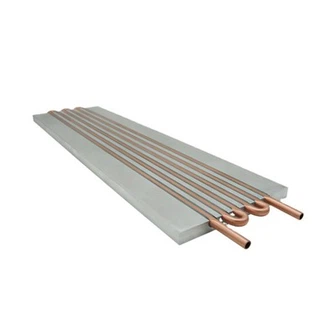
3D VC Technology used in 5G Base Stations
With the rapid development of 5G technology, efficient cooling and thermal management have become important challenges in the design of 5G base stations. In this context, 3D VC technology (3D two-phase temperature equalization technology), as an innovative thermal management technology, provides a solution for 5G base stations. With the increasing number of shared scenarios jointly built by operators, the demand for "high-power, full bandwidth" is gradually increasing. Distributed 5G base stations are constantly developing towards the direction of multi frequency integration, leading to a continuous increase in base station power consumption and a continuous increase in power thermal density, posing a huge challenge to base station thermal management.

Two phase heat transfer relies on the latent heat of the working fluid phase change to transfer heat, which has the advantages of high heat transfer efficiency and good temperature uniformity. In recent years, it has been widely used in electronic equipment heat dissipation. From the development trend of two-phase temperature equalization technology, it can be seen that from linear temperature equalization of one-dimensional heat pipes to planar temperature equalization of two-dimensional VC, it will eventually develop into three-dimensional integrated temperature equalization, which is the path of 3D VC technology:

3D VC refers to the process of connecting the substrate cavity with the PCI tooth cavity through welding, forming an integrated cavity. The cavity is filled with working fluid and sealed. The working fluid evaporates on the side of the substrate cavity near the chip end, condenses on the side of the tooth cavity at the far heat source end, and forms a two-phase cycle through gravity drive and circuit design, achieving ideal temperature equalization effect.

3D VC can significantly improve the average temperature range and heat dissipation capacity, with technical characteristics such as "high thermal conductivity, good average temperature effect, and compact structure"; 3D VC further reduces the heat transfer temperature difference through the integrated design of the substrate and heat dissipation teeth, increases the uniformity of the substrate and heat dissipation teeth, improves the convective heat transfer efficiency, and can significantly reduce the chip temperature in high heat flux areas. It is the key to solving the heat transfer problem in high heat flux scenarios of future 5G base stations, and provides the possibility for miniaturization and lightweight design of base station products.

The 5G base station has locally high heat flux density chips, causing difficulties in local heat dissipation. Through current technologies such as thermal conductive materials, shell materials, and two-dimensional temperature equalization (substrate HP/tooth PCI), the thermal resistance of heat sinks can be reduced, but the improvement in heat dissipation for high heat flux areas is very limited.
Without introducing external moving components to enhance heat dissipation, 3D VC efficiently transfers heat from the chip to the far end of the teeth for heat dissipation through the thermal diffusion of a three-dimensional structure. It has the advantages of "efficient heat dissipation, uniform temperature distribution, and reduced hot spots" and can meet the bottleneck requirements of high-power device heat dissipation and high heat flux area temperature equalization.

3D VC breaks through the thermal conductivity limitations of materials through phase change homogenization, greatly improving the homogenization effect, and has a flexible layout and diverse forms. It is a key technical direction for future 5G base stations to meet the requirements of high-density and lightweight design; Besides, 3D VC, as an innovative thermal management technology, has great application advantages in 5G base stations. It can match the "high-power, full bandwidth" development of 5G base stations and meet customers' "lightweight, high integration" needs. It is of great importance and potential value for the development of 5G communication.