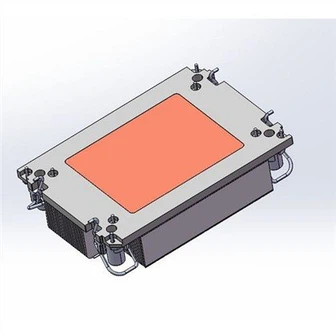
Are you really using the pin fin radiator right?
The heat sink for heat dissipation simulation is an unnecessary component, and you should also have an understanding of its performance, especially the plate type heat sink. We all know that the heat dissipation performance of a plate-type radiator is related to the height, thickness, spacing of the heat dissipation ribs and the thickness of the bottom plate.
However, as the thickness of the radiating rib increases, the spacing decreases, and the thickness of the bottom plate increases, the performance of the radiator first rapidly improves, then slowly increases, and finally becomes lower.
Therefore, reasonable control of the thickness, spacing and thickness of the bottom plate of the radiating ribs is the key to the design of the radiator, and it is not a generalized optimization combination, and adjustments should be made according to the actual product.
Based on the above understanding of the plate-type radiator, some people think that the pin-fin radiator has inherent advantages. Because of the heat transfer equation Q=hA(T1-T2), the larger the area of the radiator, the stronger its heat dissipation capacity.
The design concept of the needle-shaped radiator is to generate as much heat exchange area as possible in a given volume, and it can also adapt to different airflow directions.
For the pin-fin radiator, only the surface area in the same direction as the airflow can contact the flowing air, and the surface area in the vertical airflow direction is only in contact with still air or vortex airflow, and this part of the surface area cannot take away much heat. Therefore, under the same fin spacing, just breaking the plate-shaped fins does not increase heat dissipation, but may have worse heat dissipation performance.
It is true that the spacing of the plate-type fin radiator cannot be made too dense due to technological constraints. The density of the fins can be increased by making needle-shaped fin radiators, but do not ignore the parameter h. After the density is increased, it flows through two The air in the fins will interfere with each other, collide with each other and squeeze into the narrow flow between the two fins, forming turbulence.