Common terms in Thermal Design
In thermal design, we often encounter many professional terms. To better understand the working principle of thermal design scheme, familiarity with these common terms is an essential part of knowledge.
PCB:
Which means PrintedCircuit Board ,It is an important electronic component, which is connected with each other through a single board. "Wiring" are often referred to as how the signal lines between components are arranged inside the board.

Heatsink:
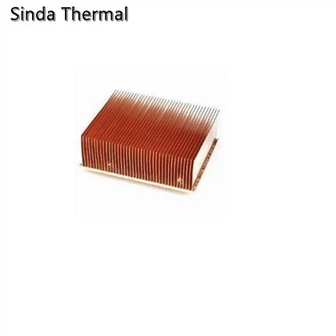
It is usually made of aluminum and copper, mostly in the shape of fins, which is used to achieve greater contact area with the outside in a certain space, taking into account the resistance to the fluid.
Generally speaking, all structural members that can absorb the heat of the heat source and then dissipate into the surrounding environment can be called heatsinks.

Fan:
A fan is a component used to accelerate the flow of air. Also known as fan. It is divided into axial fan and centrifugal fan.

Thermal Interface Material:
There will be small gaps between rigid solid contact surfaces. These gaps can be filled with flexible media to connect the heat conduction path. Thermal conductive interface material is a general term of this kind of material. There are thermal pad, thermal grease and thermal gel.

Heat exchanger:
Heat exchanger can be considered as a kind of heatsink. Heat exchangers usually do not directly cool the heat source. The computer CPU liquid cooling module shown in the figure below, in which the water drain is a typical heat exchanger. This heat exchanger directly cools not the heat source, but the liquid working medium used to cool the heat source. That is, it is an indirect low cooling heat source.

Heatpipe And Vapor Chamber:
Heat pipe and vapor chamber are high heat transfer efficiency components made by using the characteristics of high heat transfer efficiency of phase change heat transfer. It is widely used in high power density scenes. Heat pipe can be simply understood as a pipe with very high thermal conductivity, while VC can be simply understood as a plate with very high thermal conductivity.

Liquid Cold Plate:
Liquid Cold plate generally refers to the structural parts assembled above the heat source and with liquid working medium flowing inside in the liquid cooling design.For consumer electronics such as CPU and GPU.