How to solve the thermal issue of new energy electric vehicle charging piles?
Compared with other power supply, the heat volume of charging pile is much larger, and the system thermal design requirements are extremely strict. The power range of DC charging pile is 30KW, 60KW and 120KW, and the efficiency is generally around 95%, so 5% of them will be converted into heat loss, and the heat loss will be 1.5KW, 3KW and 6KW.
For outdoor equipment, the heat must be dissipated from the equipment, otherwise it will accelerate the aging of the equipment. At the same time,it is necessary to deal with waterproof and dustproof treatment to prevent the short circuit and signal disorders of electronic equipment.

Understand the heat of charging piles: To give you an intuitive way to understand how much heat generated during the charging process? We compare the power of 60KW charging pile and communication power cabinet: At present, the mainstream module efficiency of the industry is 95%. Taking the 60KW system as an example, the module's heatstakes only reach 60*0.05*1000 = 3000W, which means that the charging pile is in During the charging process, the heat generated was three times than that of the heat of the communication outdoor cabinet under the same volume conditions.
The importance of the thermal management of charging piles: the purpose of building charging facilities is to replenish more than 50-60% of electric energy for vehicles to be charged in a short period of time. In practical application, electric vehicles generally use DC fast charge, which can be filled within 1 to 2 hours, while AC power used at home can only be filled in slow charge mode, which takes 6-8h.An important factor for the promotion of new energy vehicles is the convenience of the use process. Therefore, for the charging demand of electric vehicles, the faster the better, but with the acceleration of the charging speed, the current and voltage will also increase linearly, which leads to the increase of the power of the inductor module of the charging pile.Inductor module, power module and other components would generate a large amount of heat quickly. It can be seen that the heat generated by the charging pile in the charging process is large, and if it is not dissipated in time, it will cause a great safety accident. Therefore, the heat dissipation problem is one of the problems that must be solved in the promotion and construction of the charging pile system!
There are four commonly used cooling mode: natural cooling (mainly heat sinks), forced air cooling, liquid cooling, and air conditioning. Due to the influence of factors such as volume, cost, and reliability, most companies use air forced cooling method. Then, this will inevitably bring interference such as dust, corrosive gases, and moisture.
The thermal solution of the charging pile is divided into two parts: module heat dissipation and the overall heat dissipation of the chassis. Because the charging module is built -in inside, the protection measures are mainly reflected in the design of the chassis. One of the simplest economics is to make a shutter type at the inlet and outlets of the box, and then add a fan at the air outlet to remove the heat from the module fan. This method can play a certain protective role. It is still inevitable that there will be dust and moisture. If you want a better protective effect, you can use a closed hot and cold quarantine air duct to perform hot and cold isolation internally (as shown in the figure below): the septum is completely separated by the hot and cold fluid. The inlet and outlets at both ends are selected from the shutter filter group to effectively waterproof and dustproof.
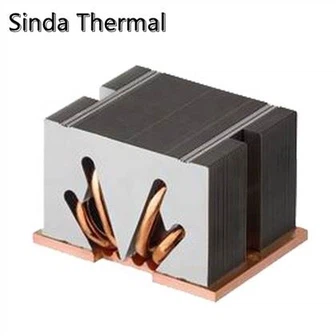
Sinda Themral is a leading heat sink manufacturer, we can design and produce every generation of Intel, AMD,etc. CPUs, Our factory owns many precise facilities and equipment to manufacture high quality CPU heat sinks. We are a thermal partner with many customers in the world like Flex, DellEMC, Foxconn, etc. Please contact us if you have any thermal requirements.