

Vapor Chamber heatsink application
A vapor chamber is composed of sealed copper plates and filled with a small amount of fluid (such as deionized water), allowing heat to quickly dissipate from the heat source. The vapor chamber heat sink has a supporting structure inside, which can prevent the cavity wall from bending. The vapor chamber is formally called a heat pipe and is one of the best heat dissipation options for the heat sink substrate, usually used in high-power equipment. The uniform temperature plate is generally combined with the fins to achieve efficient cooling.

The vapor chamber is composed of a sealed vacuum container with a microstructure on the inner wall and a small amount of working fluid that is in equilibrium with its own gas. Vacuum containers are usually made of copper and sealed around the periphery. The microstructure of the inner wall can be made of many different substances. The most common method is to sinter copper powder onto the inner wall of the container. Many fluids can be used as working fluids for vapor chamber heatsink . However, in most CPU, GPU, and LED cooling applications, water is usually chosen as the working fluid due to its high latent heat, high surface tension, high thermal conductivity, and cost and environmental considerations.
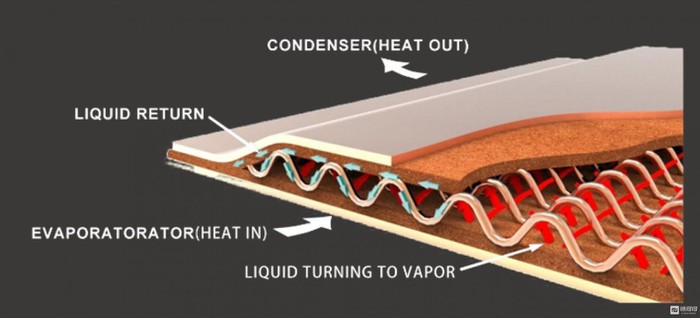
The low pressure inside the chamber causes the fluid to evaporate at a temperature much lower than its normal boiling temperature. When heat is applied to vapor chamber heatsink , the fluid near that location immediately evaporates and fills the entire chamber (driven by pressure difference). When steam comes into contact with a cooler inner wall surface, it condenses and releases heat, and the condensed fluid returns to the heat source through the capillary action of the microstructure. As the cycles of vaporization and condensation repeat, the heat from the heat source is moved throughout the entire chamber, resulting in a uniform temperature distribution on the surface of the chamber.
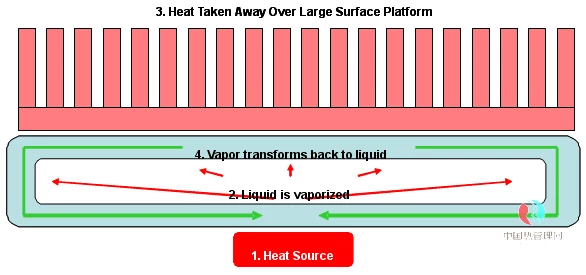
Under appropriate design, the heat dissipation of the vapor chamber can be improved by 10-30% compared to copper radiators. In some device applications, using a temperature equalization plate eliminates the need to install a fan on top of the radiator, and can also lower the temperature to the desired level, improving the reliability of the cooling system and eliminating noise.


