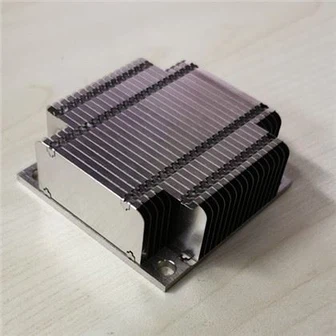
Vapor Chamber thermal design reference
Vapor chambers is directly is also called steam chamber, which is generally called plane heat pipe, temperature equalizing plate and heat equalizing plate in the industry. With the continuous improvement of chip power density, VC has been widely used in the heat dissipation of CPU, NP, ASIC and other high-power devices.

VC heatsink is better than heat pipe or metal substrate heatsink:
Although VC can be considered as a planar heat pipe, it still has some core advantages. It has a better temperature equalizing effect than metal or heat pipe. It can make the surface temperature more uniform (reduce hot spots). Secondly, using VC heatsink can make direct contact between heat source and equipment, so as to reduce thermal resistance; The heat pipe usually needs to be embedded into the substrate.

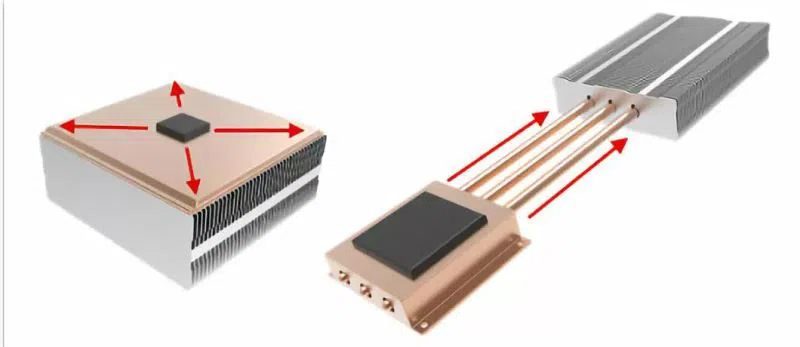
Use VC to equalize the temperature instead of transferring heat like a heat pipe:
Heat pipes are ideal choice for connecting heat sources to distal fins, especially for relatively tortuous paths. Even if the path is straight and the heat needs to be transferred remotely, heat pipes are more used than VC. This is the key difference between heat pipe and VC. Heat pipe focuses on transferring heat.
Use VC when thermal budget is tight:
The maximum ambient temperature of the product minus the maximum temperature of die is called thermal budget. For many outdoor applications, this value is greater than 40 ℃.

The VC area shall be at least 10 times the heat source area:
Familiar tothe heat pipe, the thermal conductivity of VC increases with the increase of length. This means that VC with the same size as the heat source has little advantage over copper substrate. The area of VC should be equal to or greater than ten times the area of heat source. When the thermal budget is large or the air volume is large, this may not be a problem. However, in general, the basic bottom surface needs to be much larger than the heat source.

Other Consideration factors:
Size: Theoretically, there is no size limit, but the length and width of VC used for cooling electronic equipment rarely exceed 300-400 mm.
The thickness of conventional VC is between 2.5-4.0mm.
Power Density: The ideal application of VC is that the power density of heat source is greater than 20 W / cm2, but many equipment actually exceed 300 W / cm2.
Surface Treatment: Nickel plated is often used
Working Temperature: VC can withstand multiple cold and heat shocks, but their typical working temperature range is 1-100 ℃.
Pressure: VC is usually designed to withstand a pressure of 60 psi before deformation. Many actual product can up to 90 PSI.