



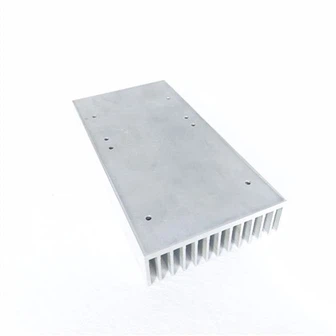
Aluminum Extruded Peltier Cpu Radiator
Peltier phenomenon: Two different conductors are connected to form a galvanic couple and connected to a DC power supply. When a current flows through the galvanic couple, an energy transfer phenomenon will occur, one joint emits heat and becomes hot, and the other joint absorbs heat and become cool, This phenomenon called the Peltier effect. The internal structure of a Peltier element consists of a semiconductor chip made of N-type and P-type bismuth telluride materials. The chips are electrically connected in series, but in a parallel thermodynamic arrangement for optimal heat transfer between the module's high temperature and low temperature ceramic surfaces
Product Introduction
Please click the Navigation line ''visit the factory online'' to visit our factory
Peltier phenomenon: Two different conductors are connected to form a galvanic couple and connected to a DC power supply. When a current flows through the galvanic couple, an energy transfer phenomenon will occur, one joint emits heat and becomes hot, and the other joint absorbs heat and become cool, This phenomenon called the Peltier effect.
The internal structure of a Peltier element consists of a semiconductor chip made of N-type and P-type bismuth telluride materials. The chips are electrically connected in series, but in a parallel thermodynamic arrangement for optimal heat transfer between the module's high temperature and low temperature ceramic surfaces
Thermoelectric cooling takes advantage of the Peltier effect: heat is absorbed or dissipated at the junction of two different electrical conductors when an electric current is passed through it. Thermoelectric modules sandwich a Peltier element between two highly thermally conductive ceramic plates, along with a power supply that efficiently transfers heat from the device from one ceramic plate to the other. Additionally, the direction of heat flow can be changed simply by reversing the direction of current flow.

Applying a DC voltage causes positive and negative charge carriers to absorb heat dissipated from the surface of one substrate, which is then transferred and released to the substrate on the other side. Therefore, the surface that absorbed the energy would cool down, while the other side that had released the energy would heat up.
To build a practical thermoelectric cooling unit, a Peltier module is built into the system, which is typically constructed from a block of high thermal conductivity metal (such as aluminum alloy) and a finned heat sink. Metal blocks are used to connect the device to be cooled, such as a laser diode or image sensor, to the cold side of the Peltier module. The thickness of the metal block should be chosen to help keep it flat to ensure a consistent thermal connection to the cold plate of the Peltier element, but be aware that excessive thickness can create unnecessary thermal inertia. Attach a heat sink to the other side of the Peltier element in order to dissipate the extracted heat to the environment. Apply a TIM to each side.

There are varieties of heatsink types to build a Peltier module, for low power electonic components, the most widely used heat sink type is aluminum extruded heatsink. Aluminum is an extraordinary thermal conductor, and it has an excellent heat dissipation ability; Also aluminum has some merits like cheap cost, lightweight, easily manufacturing, etc. these make aluminum alloy become the most common material. Aluminum extruded Peltier heatsink is the most popular in building a Peltier module.
Sinda Thermal is a leading thermal manufacturer in China, our factory was founded in 2014, and located in Dongguan city, China, we are offering varieties of heatsinks and other precious metal parts. Our plant possesses 30 sets advanced and high precious CNC machines and stamping machines, also we have many testing and experiment instruments and professional engineering team, so our company can manufacture and provide high quality products with high precision and excellent thermal performance. Sinda Thermal is devoted to a range of heat sinks which are widely used in new power supply, New energy vehicles, Telecommunications, Servers, IGBT, and Madical. All the products accord with Rohs/Reach standard, and the factory is qualified by ISO9001 and ISO14001. Our company has been a partner with many customers for good quality, excellent service and competitive price. Sinda Thermal is a great heat sink manufacturer for the global customers .
FAQ
1. Q: Are you a trading company or manufacturer?
A: We are a leading heat sink manufacturer, our factory has been founded over 8 years, we are professional and experienced.
2. Q: Can you provide OEM/ODM service?
A: Yes, OEM/ODM are available.
3. Q: Do you have MOQ limit?
A: No, we don't set up MOQ, prototype samples are available.
4. Q: What's the lead time of the production?
A: For prototype samples, the lead time is 1-2 weeks, for mass production, the lead time is 4-6 weeks.
5. Q: Can I visit your factory?
A: Yes, Welcome to Sinda Thermal.
Hot Tags: aluminum extruded peltier cpu radiator, China, manufacturers, customized, wholesale, buy, bulk, quotation, low price, in stock, free sample, made in China, Anodized Extruded Sink, Extruded Aluminium Heat Sink, Extruded Aluminum Sink, Extruded Aluminum LED Heatsink, Round Extruded Aluminum Heatsink, Extruded Heat Sink
You Might Also Like




Send Inquiry
