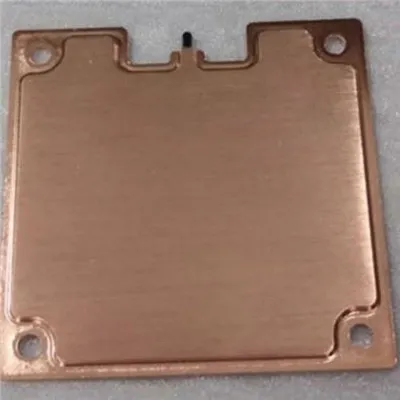
An Ultralight Capillary-Driven Heat Pipe cooling technology
Capillary driven heat pipes, due to their simple design, low cost, flexible design, and good heat dissipation ability, may be the most popular solution for contemporary thermal management microelectronic components. In smartphones and laptops, flatten the universal tubular design to further compress. The principle of heat pipes is to propagate the excess heat emitted by microelectronic components through the latent heat conversion of the working fluid in a vacuum chamber. The cold and hot ends of the enclosure structure serve as evaporators and condensers respectively, while the function of the middle part is to provide channels for (i) steam flow (from the hot end to the cold end) and (ii) condensate flow (from the cold end to the hot end) through capillary action through the wick structure through the central hollow area. In the middle, steam and condensate flow in the opposite direction, separated by a free surface interface caused by surface tension flow force. The design goal of a heat pipe is to reduce the operating temperature of components attached to the evaporator by allowing heat to be transported along the heat pipe and dissipated at the condenser end.

Recently, Professor Kiju Kang from Chonnam National University in South Korea has made the latest progress in thermal solutions for electronic cooling systems. Capillary driven heat pipes are an effective thermal solution for compressed electronic cooling systems, providing an ultra lightweight heat pipe thermal solution for mobile applications. In this study, the shell that encapsulates the phase change process of the working fluid was formed by a thickness of~40 μ Made by chemical plating of m. In addition, the wick structure that transports the condensate to the heat source through capillaries is also chemically plated onto the inner surface of the casing, forming a 100 μ M thick microporous layer.

This wick structure is sequentially superhydrophilized by forming nano textured blackening on the microporous wick layer. The effective density of our prototype ultra-light heat pipe (UHP), as a measure of lightweight, indicates that on average, commercial products of the same type with sintered copper cores of similar external dimensions have reduced weight by 73% (e.g., about 2.7 g compared to~10.0 g), while providing equivalent heat dissipation. In addition, due to the additional heat dissipation of the ultra-thin wall shell and lamp core, uHP operates with a 25% decrease in evaporator temperature.