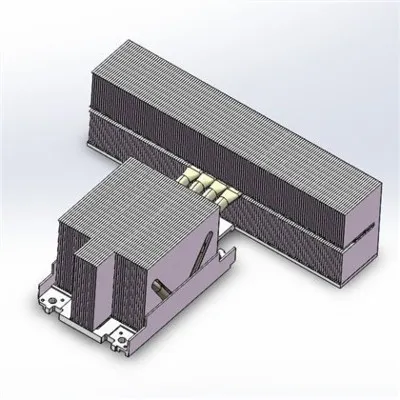
Basic knowledge of skived fin heatsink
Skived fin, also known as skiving technology, simply means that a whole piece of aluminum or copper is cut into fins with standard spacing and certain thickness and height through a special shovel according to needs. Due to the use of high-precision cutting technology and integrated forming, compared with other processing processes, raw materials with the same volume can cut a larger heat dissipation area, and the heat transfer performance is more stable. Compared with the crimped fin heatsink, it can improve the heat dissipation efficiency by 10-30%, so as to greatly improve the heat dissipation efficiency and prolong the service life of heating components.

Since the fin and the base plate belong to the same material, there is no contact thermal resistance between the cooling fin and the base plate, and the ratio of the height of the fin to the spacing of the fin is very large (copper can reach 25 and aluminum can reach 60). In this way, the cut heat dissipation fins are thin and dense, greatly increasing the heat dissipation surface area. Even if the air volume is reduced again, the radiator can still achieve good heat dissipation effect, thus greatly reducing the noise generated by the fan, and can dissipate a large amount of heat in a limited space to meet the heat dissipation requirements.

Advantages of high densityskived fin heatsink:
(1) The skived fin heatsink has higher fin density to improve the heat dissipation area and heat dissipation performance;
(2) The fin height can reach 120mm, which fully meets the production requirements of most radiators;
(3) The fin can be made thinner, generally 1.5mm or even 1.0mm, which can make the radiator lighter;
(4) The skiving heatsink is shoveled on the prototype material, so the heat dissipation efficiency is not damaged, reaching 100% of the heat dissipation efficiency of the prototype material, and there will be no risk of loosening and falling off, so as to improve the reliability of machine operation;
(5) The skived fin has high compatibility and high possibility of later processing. It can also cooperate with the buried heat pipe process to improve the heat dissipation performance.