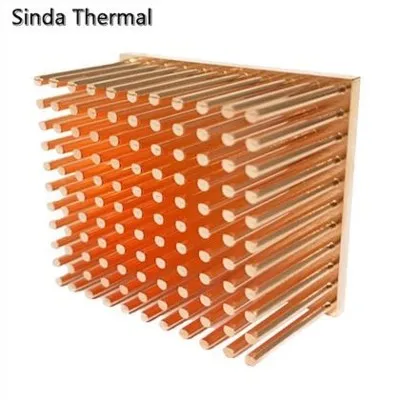
common Heatsink production process
Heat sink is a cooling device for radiating easily heated electronic components in electrical appliances. It is mostly made of aluminum alloy, brass or bronze in plate shape, sheet shape, multi sheet shape, etc. for example, a considerable heat sink should be used for CPU in computer, and a heat sink should be used for power tube, line tube and power amplifier tube in TV. Different electronic devices will choose heat sinks with different performance according to the actual application. Due to the different performance requirements, the heat sinks also have different manufacturing processes.

Extruded Process:
Aluminum extrusion technology simply means that the aluminum ingot is heated to about 520 ~ 540 ℃ at high temperature, and the aluminum liquid flows through the extrusion die with grooves under high pressure to make the primary embryo of the heat sink, and then the primary embryo of the heat sink is cut and grooved to make the common heat sink. The extrusion technology has been widely used in the low-end aluminum market, and its cost is relatively low. The commonly used aluminum extrusion material is aa6063, which has good thermal conductivity (about 160 ~ 180 w / m.k) and processability.
However, due to the limitation of its own material, the ratio of the thickness and length of the fin cannot exceed 1:18, so it is difficult to improve the cooling area in a limited space. Therefore, the heat dissipation effect of the aluminum extruded heat sink is relatively poor, and it is difficult to be competent for today's rising high-frequency CPU.

Aluminum Die casting :
In addition to the aluminum extrusion technology, another process method often used to manufacture heat sink is aluminum die casting. After melting the aluminum ingot into liquid, it is filled into the metal model, and the heat sink is made by die casting directly by the die casting machine. The pressure injection method can make the fins into a variety of three-dimensional shapes. The heat sink can be made into complex shapes according to the demand, and the heat sink with diversion effect can also be made in cooperation with the fan and air flow direction, Thin and dense fins can be made to increase the heat dissipation area. It is widely used because of its simple process.

Folder fin :
The folder fin heat sink is to fold the thin copper or aluminum sheet into an integrated fin by the forming machine, then fix the upper and lower bottom plates with the puncture die, and then weld it with the processed base by using the high-frequency metal welding machine. Because the process is continuous joint, it is suitable for making heat sink with high thickness length ratio, and because the fin is formed as a whole, which is conducive to the continuity of heat conduction, the thickness of the fin can be 0.1mm, which can greatly reduce the demand for materials, The maximum heat transfer area is obtained within the allowable weight of the heat sink. In order to achieve mass production and overcome the interface impedance during material bonding, the upper and lower bottom plates are fed at the same time in the manufacturing process, and the automatic consistent manufacturing process is adopted. The upper and lower bottom plates are bonded by high cycle fusion welding, that is, material fusion to prevent the generation of interface impedance, so as to establish high-strength and closely spaced heat sinks. Because the process is continuous, it can be produced in large quantities, and because the weight is greatly reduced and the efficiency is improved, the heat transfer efficiency can be increased.

Cold Forging:
Cold forging is a process of forging and forming raw materials with a specific die tooling at room temperature. Cold forging includes upsetting, die forging, extrusion and other deformation forms, which belongs to cold volume forming. Cold forging products are of good quality, processed at room temperature, with high dimensional accuracy, smooth surface and good mechanical properties. It can also process forgings with complex shapes, reduce cutting, save material consumption and reduce cost.

With the increasing demand for heat dissipation, the design of heatsink is becoming more and more diversified, which makes more and more manufacturing processes applied in the heatsink production. In the future, the manufacturing process of heatsink will become more mature with the progress of technology to help electronic equipment dissipate heat efficiently·